Section 1: The Problem
Counterfeit products are no longer limited to obviously fake designer bags sold on street corners. They move through international supply chains, online marketplaces, social-media storefronts, warehouses, and millions of small parcels. Fake clothing, shoes, electronics, cosmetics, automotive parts, and luxury products can look convincing enough that even experienced buyers struggle to tell the difference.
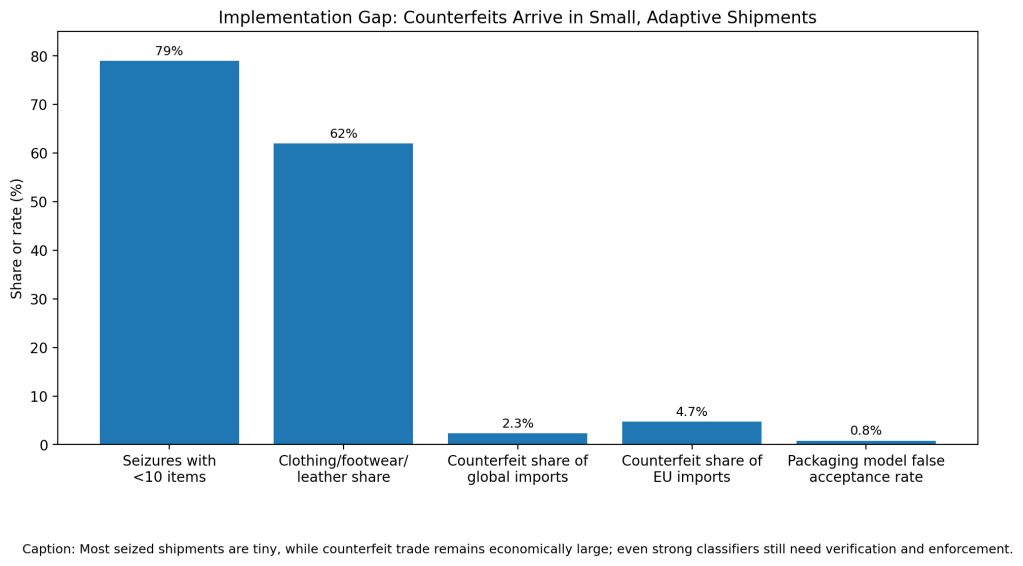
The economic scale is enormous. The OECD and European Union Intellectual Property Office estimated that counterfeit and pirated goods represented approximately $467 billion in global trade in 2021, equal to 2.3% of worldwide imports. For the European Union, counterfeits represented an estimated $117 billion, or 4.7% of total imports (OECD and EUIPO).
Traditional authentication depends on experts examining stitching, labels, logos, materials, serial numbers, packaging, and manufacturing details. That works for one suspicious handbag. It does not scale to marketplaces processing billions of listing changes or customs agencies confronting huge numbers of small packages.
Section 2: What Research Shows
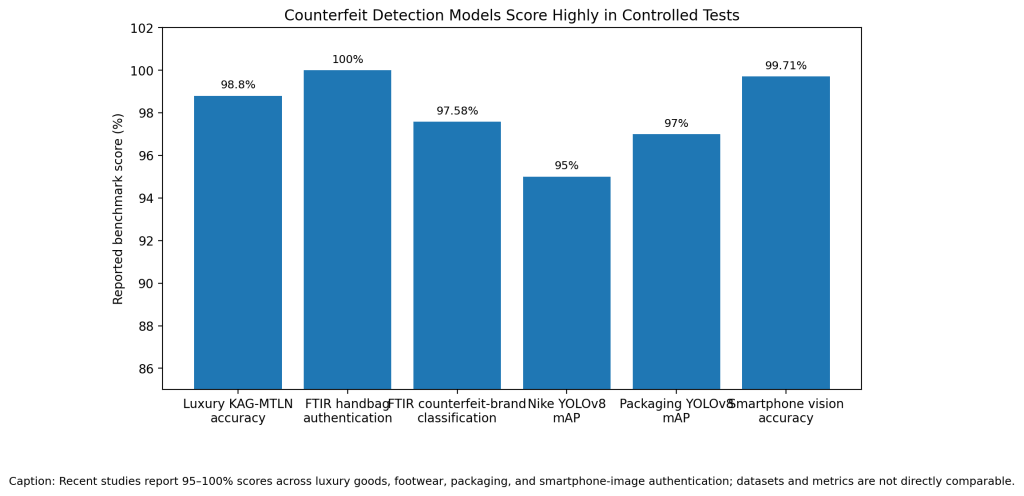
Computer vision can learn the tiny differences that counterfeiters struggle to reproduce consistently. Yang and colleagues developed a multi-task network that focused on key regions such as leather tags, metal buckles, lettering, and round labels on luxury goods. Their model reached 98.8% accuracy across several real-world luxury-product datasets. Even after the training sample size was reduced by 80%, accuracy remained 92.1% (Yang et al.).
Panchal and Vora trained YOLOv8 to distinguish original and counterfeit Nike Air Force and Jordan shoes using 3,860 images. The system reached 95% mean average precision, with 92.2% precision and 91.8% recall. The study demonstrates that visible characteristics such as construction, logos, and shape can provide enough information for automated screening (Panchal and Vora).
Some systems look beneath the surface. Yuan and colleagues combined infrared spectroscopy with machine learning to authenticate luxury handbags. Their models reached 100% accuracy when separating genuine from counterfeit bags and 97.58% accuracy when classifying counterfeit bags among three brands (Yuan et al.). A 2026 packaging study using an improved YOLOv8 model reported 0.97 mAP with a 0.8% false-acceptance rate for tiny anti-counterfeit markings (Jiang and Liu).
Section 3: What the Real World Shows
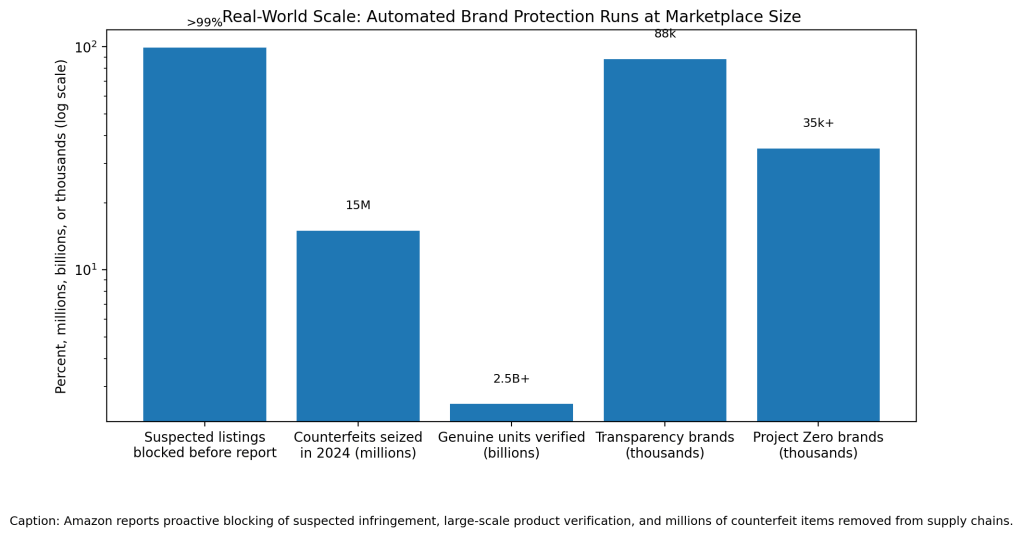
Large marketplaces already use these ideas at a scale far beyond a research dataset. Amazon says its automated technology and AI scan billions of attempted product-page changes every day. Its systems combine text, images, prices, seller behavior, brand information, and other risk signals instead of judging a product photograph alone (Amazon).
Amazon reported that its proactive controls blocked more than 99% of suspected infringing listings in 2024 before a brand had to report them. During the same year, the company identified, seized, and disposed of more than 15 million counterfeit products worldwide (Amazon). Those numbers are company-reported rather than independent experimental results, but they demonstrate what real marketplace deployment looks like.
Authentication also moves into the supply chain. Amazon reports that more than 2.5 billion product units have been verified as genuine through its Transparency serialization program, with 88,000 brands enrolled. Project Zero has been used by more than 35,000 brands, combining automated protections with brands’ ability to remove suspected counterfeit listings themselves (Amazon).
Section 4: The Implementation Gap
The first problem is that laboratory accuracy does not automatically transfer to every product. Counterfeit detection is a fine-grained classification problem: the fake and genuine object may have almost identical colors, shapes, materials, and logos. Yang and colleagues note that datasets are difficult to build because authentic and counterfeit samples are expensive and scarce, while genuine products themselves change across product series and manufacturing generations (Yang et al.).
The second problem is adversarial adaptation. Once counterfeiters learn which feature an authentication system examines, they can improve that feature. A model trained on yesterday’s fake label may fail on tomorrow’s. Smartphone photographs introduce additional variation through lighting, camera quality, angle, compression, backgrounds, and partial obstruction. One recent computer-vision system reported 99.71% accuracy on branded garments under weakly controlled real-world imaging, but it also rejected 3.06% of samples rather than forcing a decision when confidence was insufficient (Garcia-Cotte et al.).
The third problem is logistics. OECD data show that shipments containing fewer than ten items represented 79% of counterfeit seizures in 2020–21, up from 61% in 2017–19. Counterfeiters increasingly use postal services, small parcels, local assembly, and fragmented shipping to make interception harder. Clothing, footwear, and leather goods together represented 62% of seized counterfeit products in the OECD’s latest analysis (OECD and EUIPO).
Finally, an AI flag is not proof that a seller committed counterfeiting. A listing can contain reused photography, gray-market goods, secondhand products, authorized resales, or legitimate products with unusual packaging. Automated detection therefore still needs seller verification, serial numbers, brand records, physical inspection, and a way for legitimate merchants to challenge mistakes.
Section 5: Where It Actually Works
Counterfeit detection works best as a funnel. AI can examine enormous numbers of listings and shipments, eliminate obvious low-risk cases, and send a much smaller suspicious group to brands, investigators, customs officers, or specialized authentication tools.
It also works better when several signals agree. An unusual logo alone may be innocent. An unusual logo combined with a new seller account, unrealistic pricing, copied product images, suspicious shipping patterns, and a serial number that does not exist creates a much stronger case. Amazon’s move toward multimodal models reflects this approach: text, visual attributes, price signals, and seller information are evaluated together rather than separately (Amazon).
Section 6: The Opportunity
The opportunity is not an app that photographs a sneaker and declares it fake with absolute certainty. It is an authentication system that follows a product from factory to listing to shipment to resale. Computer vision can inspect visual details, spectroscopy can verify materials, serialization can confirm identity, and seller-network analysis can reveal coordinated counterfeit operations.
The strongest future systems will also know when not to decide. A low-confidence product should be sent to an expert instead of automatically rejected. Counterfeiters are constantly adapting, so detection must remain a combination of AI, brands, customs agencies, marketplaces, and human investigation. The model can notice that something looks wrong. Stopping the fake product still requires someone to act on that warning.
References
[1] OECD and European Union Intellectual Property Office. Mapping Global Trade in Fakes 2025: Global Trends and Enforcement Challenges. OECD Publishing, 2025.
[2] Yang, Yaotian, et al. “A Lightweight Multi-Task Learning Network Based on Key Area Guidance for Counterfeit Detection.” Signal, Image and Video Processing, vol. 18, 2024, pp. 4675–4685.
[3] Panchal, Aniket, and Neha Vora. “Deep Learning Based Counterfeit Nike Shoes Detection Using YOLOv8 for Object Detection.” Journal of Innovative Image Processing, vol. 6, no. 3, 2024, pp. 314–328.
[4] Yuan, Haohan, et al. “ATR-FTIR Spectroscopy Coupled with Machine Learning for the Discrimination of Luxury Handbags: Authentication and Counterfeit Brand Classification.” Microchemical Journal, vol. 215, 2025, article 114335.
[5] Jiang, Yanan, and Yongxiao Liu. “Packaging Anti-Counterfeiting and Brand Protection Based on Improved YOLOv8.” Discover Applied Sciences, vol. 8, 2026, article 582.
[6] Garcia-Cotte, Hugo, et al. “Deep Neural Network-Based Detection of Counterfeit Products from Smartphone Images.” 2024.
[7] Asthana, Aman. “A Review on Counterfeiting Detection System Using Machine Learning Techniques.” 2025.
[8] Knight, Katie, et al. “A Systematic Review of Sensors to Combat Crime and Routes to Further Sensor Development.” Frontiers in Chemistry, vol. 13, 2025.
[9] Amazon. 2024 Brand Protection Report. 2025.
[10] Amazon. Trustworthy Shopping Experience Report. 2026.


Leave a Reply