Section 1: The Problem
Imagine arriving in a new country after losing your home, only to discover that the town where you’ve been assigned has few jobs you qualify for. A different city might have offered better opportunities, a familiar language community, or relatives who could help you settle in. But the placement decision has already been made.
This matters to millions of people. The United Nations Refugee Agency estimated that 2.5 million refugees would need resettlement in 2026. Yet its international target was just 120,000 resettlement places, leaving an enormous gap between need and available opportunities (UNHCR).
Even after someone reaches safety, location can shape their future. Governments must distribute refugees across communities while considering available housing, employment, local resources, and legal requirements. Those decisions are often made with limited information about which locations would work best for individual families.
Data science offers a different approach. Rather than treating every destination as equally suitable, an algorithm can examine historical integration outcomes and recommend places where particular individuals may have better opportunities.
Section 2: What Research Shows
In 2018, Bansak and colleagues developed a machine-learning system that predicted refugee employment outcomes across possible resettlement locations. It combined information about refugees with historical employment outcomes and used optimization to recommend assignments while respecting placement constraints.
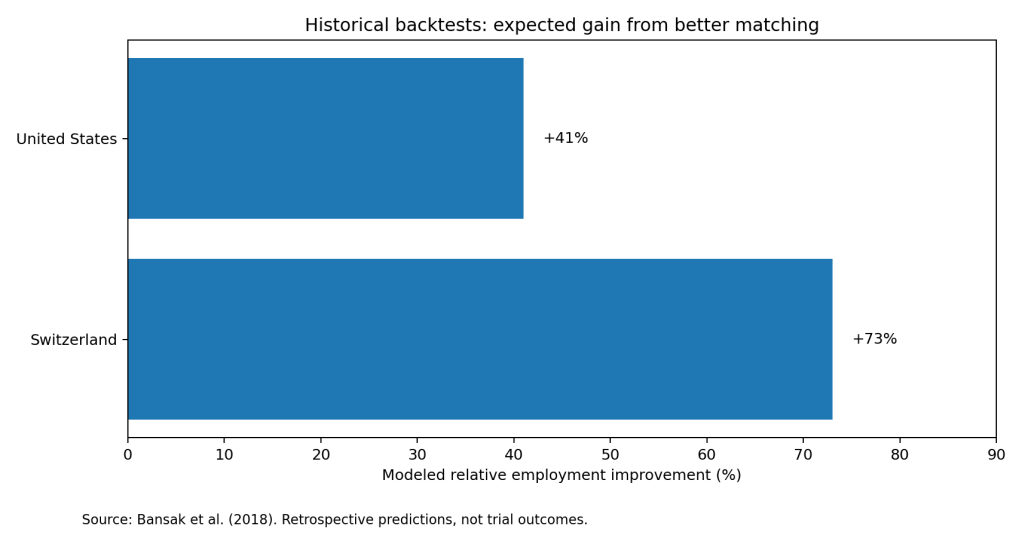
Testing the system on historical data produced substantial projected improvements. Researchers estimated that different assignments could have increased employment by approximately 41% in the United States and 73% in Switzerland compared with existing placement practices (Bansak et al.).
In Switzerland, that meant potentially raising the three-year employment rate for a historical refugee cohort from approximately 15% to 26%. These were retrospective estimates, not evidence that the algorithm had already delivered those gains in practice.
Later research improved the matching process itself. Ahani and colleagues developed a dynamic allocation approach that achieved more than 98% of theoretically optimal employment in historical simulations, compared with less than 90% for simpler placement strategies. The approach became part of the Annie MOORE software used by a U.S. resettlement agency (Ahani et al.).
Section 3: What the Real World Shows
The most important new evidence arrived in September 2026. Researchers released results from a double-blind randomized trial involving approximately 2,000 refugee cases in Switzerland between January 2020 and June 2023.
Some cases received recommendations generated by GeoMatch, while others received recommendations approximating Switzerland’s existing placement process. Placement officers retained final authority, and both officers and refugees were unaware of which recommendation method was used (Bansak et al., 2026).
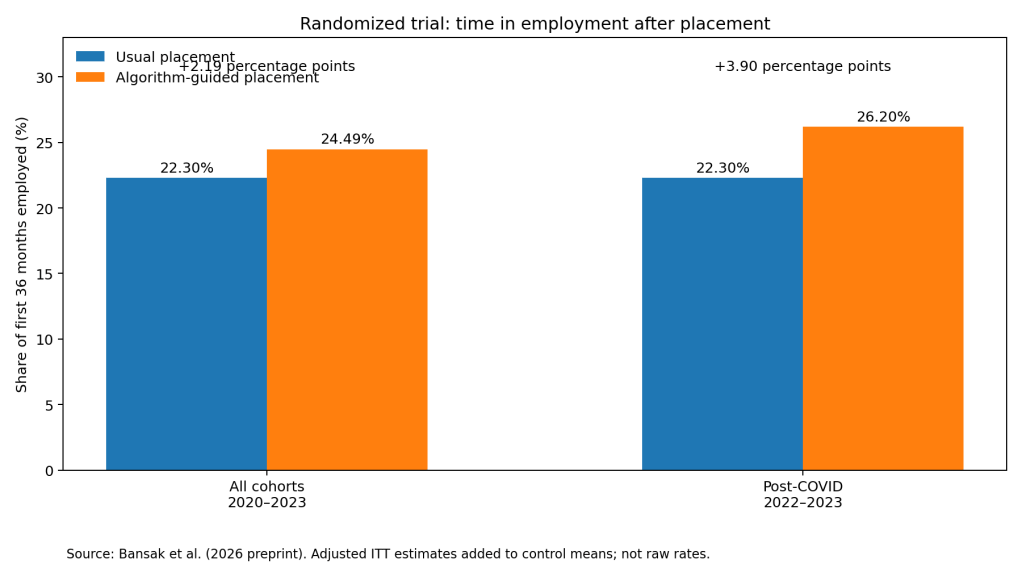
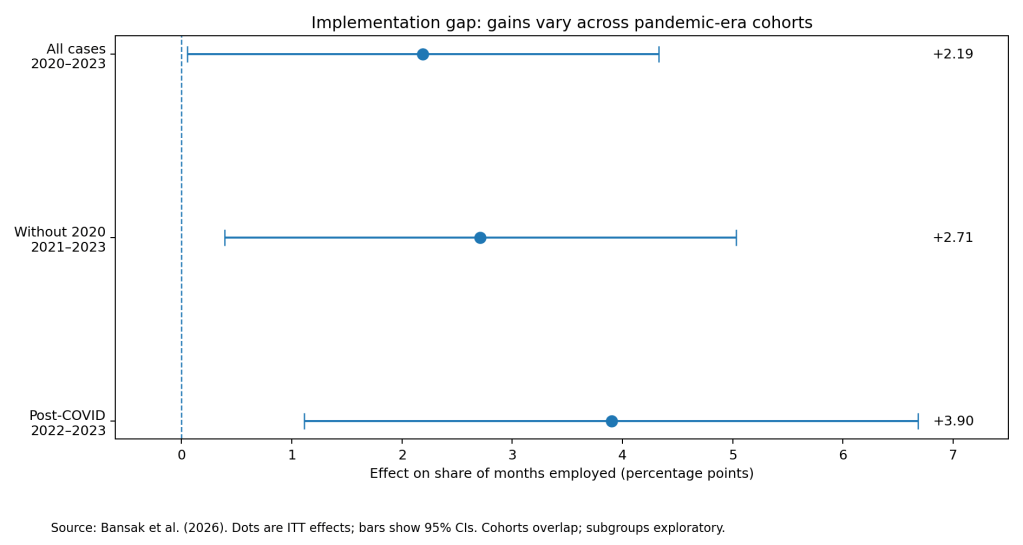
Over the first three years, refugees in the control group were employed during an average of 22.3% of months. Algorithm-guided recommendations increased that figure by an estimated 2.19 percentage points, approximately a 9.8% relative improvement. Among refugees placed in 2022 and 2023, the improvement rose to 3.9 percentage points, or approximately 17.5%.
The benefits also appeared in employment stability. Algorithm-guided placement increased the probability that at least one adult in a household held a job for six consecutive months by 5.57 percentage points.
Unlike the earlier simulations, these were observed outcomes from a randomized government deployment. However, the September 2026 findings were released as a research preprint and had not yet completed journal peer review.
Section 4: The Implementation Gap
The first problem is that historical patterns can change. The Swiss trial began just before COVID-19 disrupted employment markets. Models trained on older data struggled when businesses closed and hiring conditions shifted. Improvements were stronger among refugees placed after those disruptions eased (Bansak et al., 2026).
The second problem is missing information. The Swiss system did not have detailed data on education, work experience, occupational skills, or proficiency in local languages. A 2025 study by Strasser Ceballos and colleagues found that incorporating variables identified through migration research could improve predictive performance and fairness without sacrificing allocation quality.
The third problem is that employment is not the same as successful resettlement. A person might find work but remain separated from family, struggle to access necessary services, or feel isolated. A 2025 scoping review identified integration interventions involving employment, housing, education, and health and social services, reinforcing how many factors contribute to rebuilding a life (Namata et al.).
Fairness is equally important. A 2026 investigation of GeoMatch’s implementation in the Netherlands raised concerns that historical employment patterns could reproduce discrimination involving nationality, gender, or marital status. Researchers also questioned whether refugees had enough information and influence to challenge placement decisions (Alajak et al.).
These concerns do not erase the Swiss trial’s positive findings. They reveal a different question: even when an algorithm improves average employment, who benefits, who loses opportunities, and how much choice do families retain?
Section 5: Where It Actually Works
Algorithmic matching works best as a recommendation system within an established resettlement program. It can compare employment opportunities across destinations while accounting for available spaces, legal quotas, and family placement requirements.
Switzerland’s randomized trial demonstrates that this approach can improve outcomes without replacing placement officers. The researchers estimated substantial potential government savings from increased employment, although their cost-benefit calculations depended on assumptions about implementation costs and fiscal benefits (Bansak et al., 2026).
The stronger approach also incorporates refugees’ preferences. A family should be able to explain why a particular location matters, especially when language, family connections, accessibility, or community support outweigh a small predicted employment advantage.
Section 6: The Opportunity
The opportunity is to turn refugee placement into a better-informed decision without turning people into optimization scores. Governments could combine employment forecasts with housing availability, local services, family connections, and preferences, then give refugees and placement officers understandable options. Systems would need regular updates, independent fairness evaluations, privacy safeguards, and meaningful ways to challenge recommendations. The Swiss trial suggests that better matching can improve employment. The next challenge is proving that it also helps families build lives they actually want.
References
[1] UNHCR. 2026 Projected Global Resettlement Needs. United Nations High Commissioner for Refugees, 2025.
[2] Bansak, Kirk, et al. “Improving Refugee Integration through Data-Driven Algorithmic Assignment.” Science, vol. 359, no. 6373, 2018, pp. 325–329.
[3] Ahani, Narges, et al. “Dynamic Placement in Refugee Resettlement.” Operations Research.
[4] Bansak, Kirk, and Elisabeth Paulson. “Outcome-Driven Dynamic Refugee Assignment with Allocation Balancing.” Operations Research, 2024.
[5] Bansak, Kirk, et al. “AI-Based Matching Improves Refugee Employment in a Double-Blind Randomized Trial.” arXiv, September 2026. Preprint.
[6] Namata, Carol, Eleni Hatzidimitriadou, and Edyta Mccallum. “Integration of Refugees and Asylum Seekers in Europe: A Scoping Review of Interventions.” Journal of International Migration and Integration, vol. 26, 2025, pp. 513–541.
[7] Strasser Ceballos, Clara, Marcus Novotny, and Christoph Kern. “Beyond Proxy Variables: Extending Refugee Allocation Algorithms for Equitable Predictions.” Proceedings of the AAAI/ACM Conference on AI, Ethics, and Society, 2025.
[8] Alajak, Kinan, et al. “GeoMatch/MisMatch: A Critical Investigation of a Refugee Resettlement and Labour Market Integration Algorithm in the Netherlands.” Social Inclusion, vol. 14, 2026.
[9] Lee, Seungeon, et al. “Matchings, Predictions and Counterfactual Harm in Refugee Resettlement Processes.” Proceedings of the Fourth Conference on Causal Learning and Reasoning, 2025, pp. 260–291.
[10] Al-Hamad, Areej, Yasin M. Yasin, and Kateryna Metersky. “Predictors, Barriers, and Facilitators to Refugee Women’s Employment and Economic Inclusion: A Mixed Methods Systematic Review.” PLOS ONE, vol. 19, no. 7, 2024.


Leave a Reply