Section 1: The Problem
Volcanoes rarely come with a countdown clock. Before an eruption, scientists may see small earthquakes, gas changes, ground swelling, temperature shifts, or changes in volcanic tremor. The challenge is deciding which signals mean magma is actually approaching the surface and which are harmless unrest.
The stakes are enormous. An estimated 800 million people live within 100 kilometers of a volcano that has erupted during the Holocene. The Smithsonian Global Volcanism Program currently lists 1,214 Holocene volcanoes and reported 47 volcanoes with eruptive activity during 2026 through its March 31 database update (UNDRR; Global Volcanism Program).
The 2019 eruption of Whakaari/White Island in New Zealand shows why short warning times matter. Forty-seven people were on the island when it erupted; 22 eventually died and 25 were injured, most seriously (New Zealand Coroners Court). Traditional volcano alert systems depend heavily on scientists interpreting many separate streams of information, which can be difficult when a dangerous eruption develops quickly.
Section 2: What Research Shows
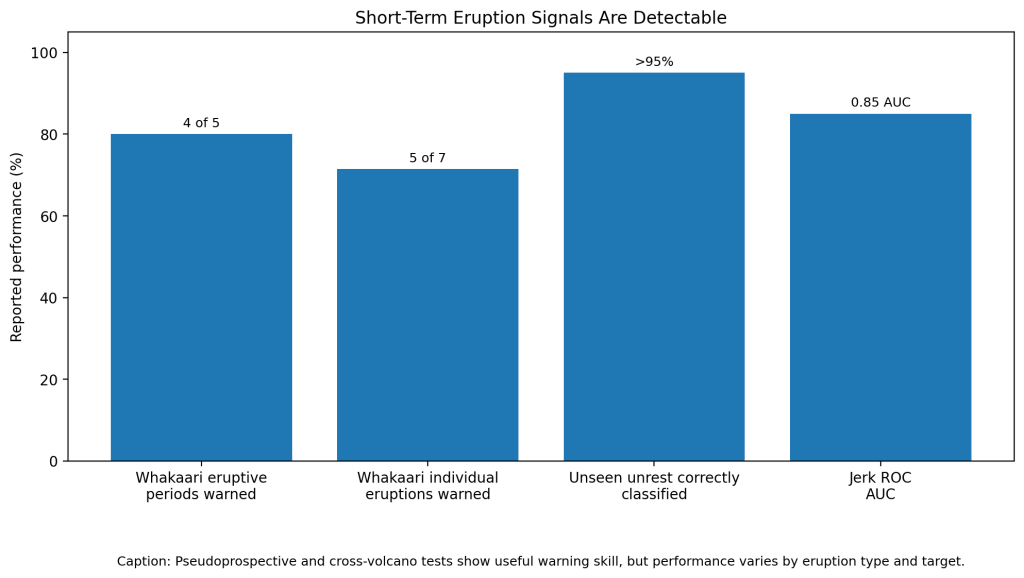
Machine learning can search years of seismic records for precursor patterns that are difficult to see manually. Kilgour and colleagues processed nine years of Whakaari seismic data and built a forecasting system that updated every ten minutes. In pseudoprospective testing, it gave advance warning for four of five eruptive periods and five of seven individual eruptions. For the fatal 2019 eruption, the model would have issued an alert about 17 hours beforehand, with its strongest signal four hours before the event (Kilgour et al.).
Researchers are also trying to make models transferable. Rey-Devesa and colleagues trained a neural-network approach using seismic features from Etna, Bezymianny, Colima, Mount St. Helens, and Augustine. When applied to an unseen month of quiet Bezymianny data, more than 95% of observations were correctly classified as unrest rather than pre-eruptive activity. The model was designed to estimate changing eruption probability from hours to days ahead (Rey-Devesa et al.).
A 2024 volcanology review nevertheless emphasizes that different volcanoes and conduit systems produce different precursors. Some eruptions produce signals months ahead, while open-conduit systems may change only minutes before eruption. That makes one universal warning rule difficult (Acocella et al.).
Section 3: What the Real World Shows
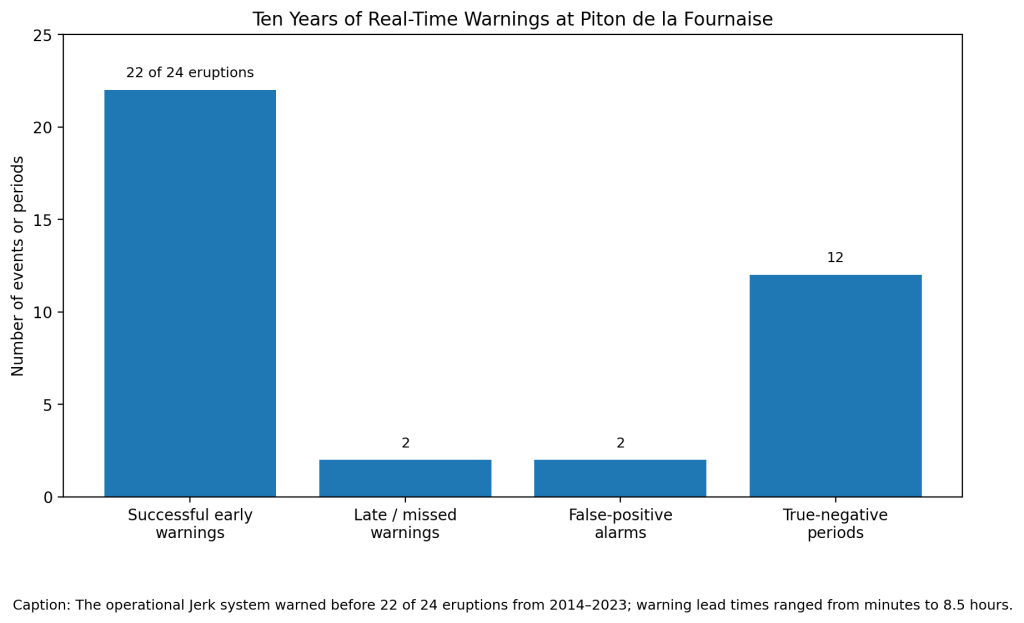
The strongest evidence comes from Piton de la Fournaise on Réunion Island. Scientists installed an automated system in 2014 that watches for a subtle seismic signal called “Jerk,” associated with shallow rock fracturing and magma movement. It sends an alert automatically when the signal crosses a threshold (Beauducel et al.).
Over ten years of real operation, the system produced useful advance warnings before 22 of 24 eruptions, a 92% true-positive rate. Two alarms arrived too late, and two alarms occurred during magma intrusions that did not produce eruptions. Warning time ranged from minutes to as much as 8.5 hours. The system’s reported ROC area was 0.85 (Beauducel et al.). This matters because it is not a simulation—the alarms were being generated while the volcano was actually being monitored.
Data-driven forecasting can also continue after an eruption begins. During Mauna Loa’s 2022 eruption, USGS scientists began lava-inundation modeling within about 40 minutes of the main northeast-rift fissure opening. Updated observations were repeatedly fed into the model, which ultimately reproduced the routing and arrival timing of the 19-kilometer lava flow that approached within 2.8 kilometers of a major highway (U.S. Geological Survey).
Section 4: The Implementation Gap
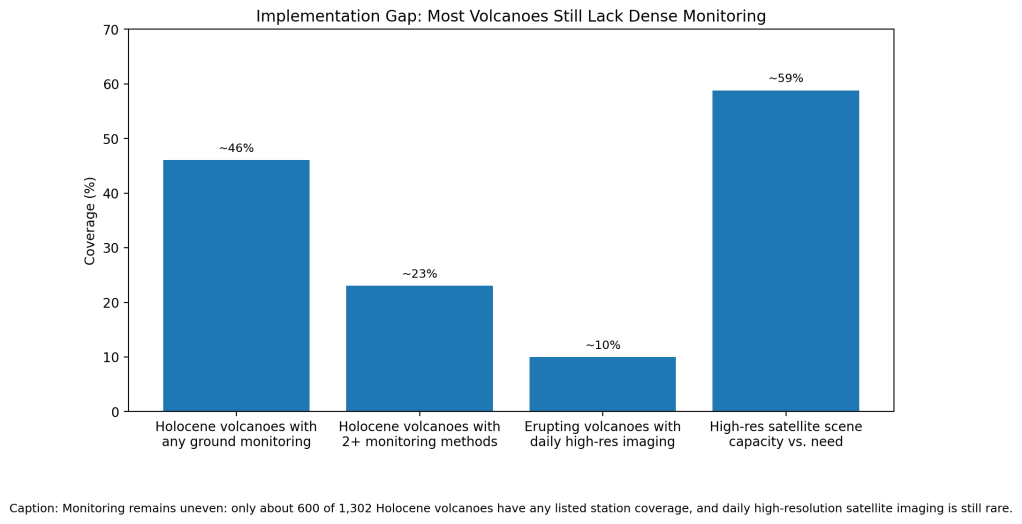
The first barrier is monitoring coverage. A 2024 global infrastructure database found monitoring stations at only about 600 of 1,302 Holocene volcanoes. Only around 300 had at least two monitoring methods, such as seismic, deformation, or gas measurements (Loughlin et al.). A forecasting model cannot detect a precursor if no instrument records it.
The second barrier is satellite frequency. Poland and colleagues report that only about 10% of erupting volcanoes currently receive daily high-spatial-resolution satellite imaging. Existing programs provide roughly 10,000 high-resolution scenes per year, while approximately 17,000 would be needed for daily coverage of all restless and erupting volcanoes (Poland et al.).
The third barrier is false alarms. Whakaari’s researchers showed that lowering a model’s warning threshold catches more eruptions but generates more periods when the system warns and nothing erupts. Raising the threshold reduces false alarms but increases the chance of missing the exact eruption people needed warned about (Kilgour et al.).
Finally, forecasting is only one part of an early-warning system. A 2025 systematic review found major AI gaps not only in prediction but also in risk knowledge, warning communication, response preparedness, governance, and responsible deployment. A technically accurate alert has little value if decision-makers do not trust it or people do not know what action to take (Tiggeloven et al.).
Section 5: Where It Actually Works
Data-driven forecasting works best at volcanoes with continuous sensors, repeated eruptions, and observatories that can compare new signals with years of past behavior. Piton de la Fournaise is a strong example because scientists could test the same automated signal repeatedly over 24 eruptions rather than judging a model from one dramatic event (Beauducel et al.).
The strongest systems also combine data instead of trusting one sensor. Behr and colleagues combined seismic tremor, earthquake rates, and three volcanic-gas measurements at Whakaari. Their Bayesian model showed increasing eruption probability before all three explosive eruptions between 2013 and 2019 and remained usable when individual sensors were unavailable (Behr et al.).
Section 6: The Opportunity
The opportunity is not an algorithm that promises exactly when a volcano will explode. It is a warning system that continuously combines seismic signals, deformation, gases, satellites, and historical patterns, updates probabilities as new data arrive, and tells scientists when something genuinely unusual is developing. The next step is expanding monitoring to poorly instrumented volcanoes and connecting model outputs to clear evacuation and access decisions. A few extra hours may sound small. Near an erupting volcano, those hours can be the entire difference between surprise and preparation.
References
[1] Global Volcanism Program. “How Many Active Volcanoes Are There?” Smithsonian Institution, 2026.
[2] Acocella, Valerio, et al. “Towards Scientific Forecasting of Magmatic Eruptions.” Nature Reviews Earth & Environment, vol. 5, 2024, pp. 5–22.
[3] Kilgour, Geoff, et al. “Automatic Precursor Recognition and Real-Time Forecasting of Sudden Explosive Volcanic Eruptions at Whakaari, New Zealand.” Nature Communications, vol. 11, 2020.
[4] Rey-Devesa, Pablo, et al. “Universal Machine Learning Approach to Volcanic Eruption Forecasting Using Seismic Features.” Frontiers in Earth Science, vol. 12, 2024.
[5] Behr, Yannik, et al. “Probabilistic, Multi-Sensor Eruption Forecasting.” Geophysical Research Letters, 2025.
[6] Beauducel, François, et al. “Jerk, a Promising Tool for Early Warning of Volcanic Eruptions.” Nature Communications, vol. 16, 2025.
[7] Tiggeloven, Timothy, et al. “The Role of Artificial Intelligence for Early Warning Systems: Status, Applicability, Guardrails, and Ways Forward.” iScience, vol. 28, no. 11, 2025, article 113689.
[8] Poland, Michael P., et al. “Steps Toward a Satellite-Based Global Volcano Monitoring and Early Warning System: From Pilot to Demonstrator to GVEWERS.” Bulletin of Volcanology, vol. 88, 2026.
[9] Pritchard, Matthew E., et al. Optimizing Satellite Resources for the Global Assessment and Mitigation of Volcanic Hazards. U.S. Geological Survey Scientific Investigations Report 2022-5116, 2022.
[10] U.S. Geological Survey. “Real-Time Lava Flow Forecasting During the 2022 Mauna Loa Eruption Response.” 2024.


Leave a Reply