Section 1: The Problem
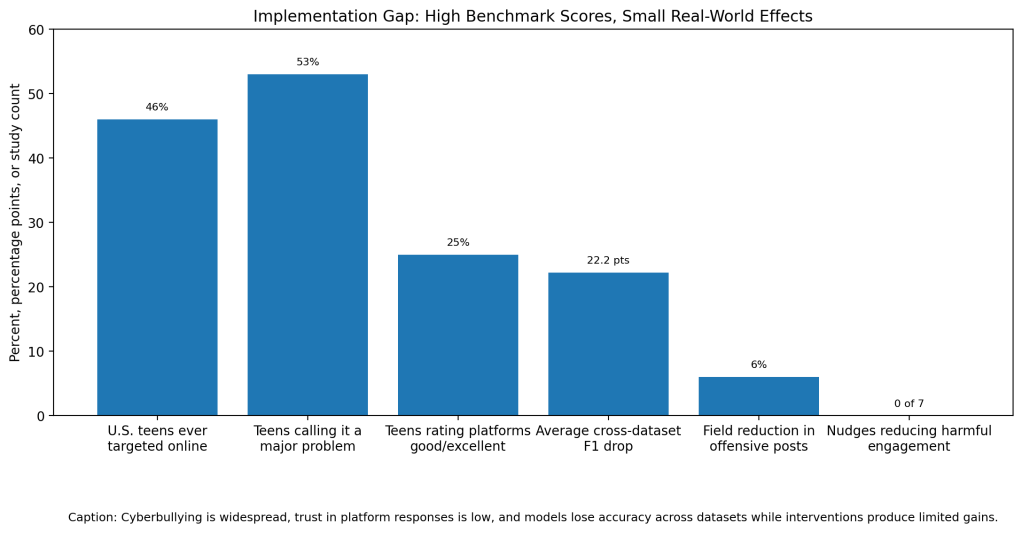
Nearly half of American teenagers have experienced at least one form of online harassment. Pew Research Center found that 46% of U.S. teens had faced behaviors such as offensive name-calling, rumor spreading, unwanted explicit images, physical threats, or persistent monitoring. More than half called cyberbullying a major problem, but only 25% rated social platforms’ handling of it as good or excellent (Vogels).
The problem extends far beyond the United States. A World Health Organization study covering adolescents across Europe, Central Asia, and Canada found that 15% had experienced cyberbullying and 12% admitted cyberbullying someone else. Both rates increased between 2018 and 2022 as young people spent more of their social lives online (WHO Regional Office for Europe).
Traditional moderation reacts after harm is posted. Users report messages, moderators investigate them, and platforms may remove content or suspend accounts. By that point, screenshots may have spread, reply chains may have grown, and the target may already have seen the abuse. Keyword filters respond faster, but they struggle with sarcasm, coded language, inside jokes, reclaimed slurs, and friendly teasing that resembles hostility without being abuse.
Section 2: What Research Shows
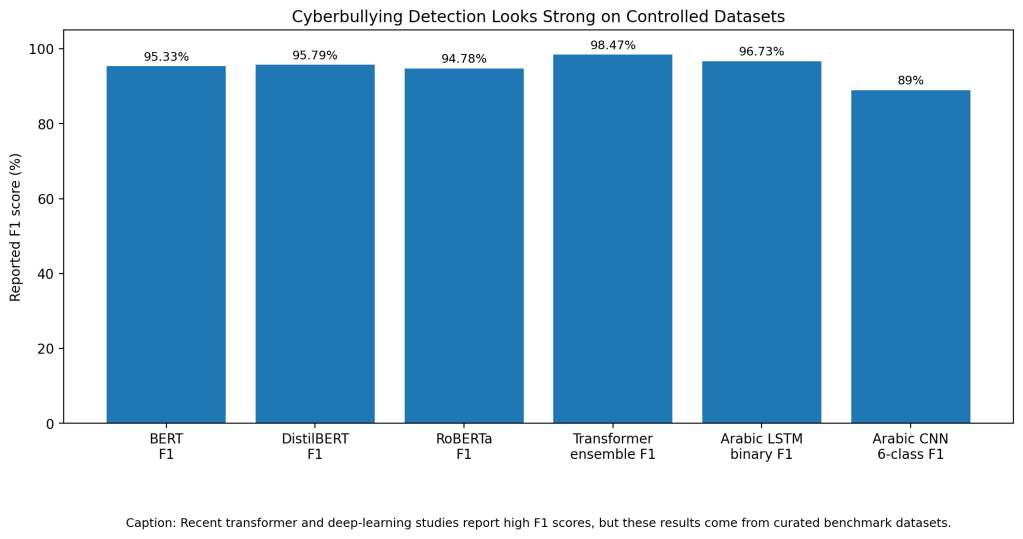
Modern language models perform extremely well on controlled cyberbullying datasets. Kumari and Kaur compared several transformer models and reported F1 scores of 95.33% for BERT, 95.79% for DistilBERT, and 94.78% for RoBERTa. Their transformer ensemble reached 98.19% accuracy and 98.47% F1, outperforming the individual models (Kumari and Kaur).
Models also work across languages when researchers build sufficiently large datasets. Alkhatib and colleagues analyzed roughly 300,000 Arabic social-media posts. Their LSTM model reached 96.73% F1 on a binary cyberbullying task, while a more difficult six-category classification task produced an F1 score around 89% (Alkhatib et al.).
Those scores hide an important limitation: a cruel sentence is not always cyberbullying, and cyberbullying is not always contained in one sentence. It often involves repetition, power imbalance, coordinated replies, account history, private relationships, and the target’s experience. A systematic review of 56 papers found that cyberbullying-detection research often lacked human-centered definitions, realistic annotation practices, deployment studies, and consideration of the harm caused by incorrect moderation (Kim et al.).
Section 3: What the Real World Shows
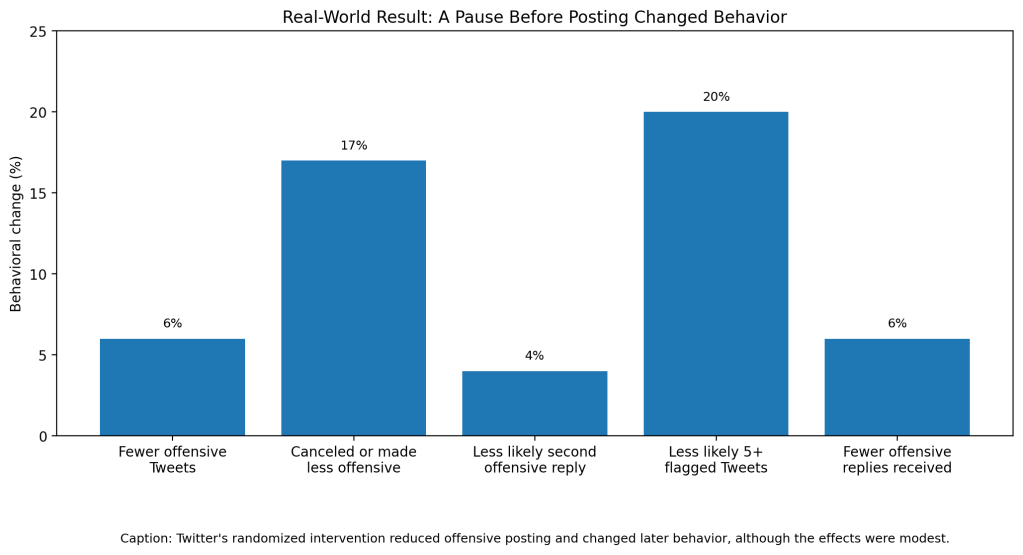
Twitter tested whether intervention could work before an offensive reply was sent. In a randomized field experiment, users who received a prompt asking them to reconsider potentially harmful language posted 6% fewer offensive tweets than users who received no prompt (Katsaros, Yang, and Fratamico).
The effect went beyond a single message. For every 100 users prompted, 9 canceled their reply and 8 rewrote it in less offensive language. After seeing one prompt, users were 4% less likely to compose another offensive reply and 20% less likely to produce five or more flagged tweets. They also received 6% fewer offensive replies from other users, suggesting that interrupting one hostile message can slightly change the conversation that follows (Twitter).
The evidence is not uniformly positive. Celadin and colleagues tested seven different design nudges with 4,081 participants using simulated social-media feeds. None significantly reduced engagement with harmful content. Some prompts increased interaction with harmless material, but they did not reliably stop users from engaging with abuse or misinformation (Celadin et al.).
Section 4: The Implementation Gap
The first barrier is model transfer. A classifier trained on one platform may fail on another because communities use different slang, labels, demographics, and definitions of harm. Root, Jakubowski, and Vanamala tested models across multiple cyberbullying datasets and found an average macro-F1 decline of 22.2 percentage points when models moved outside the datasets on which they were trained.
The second barrier is context. Twitter acknowledged that its prompting system sometimes struggled with sarcasm and friendly banter. A sentence that looks abusive to a model may be affectionate between friends, while coordinated harassment may look harmless when each message is reviewed separately. Errors become more likely when systems ignore conversation history, account relationships, images, and repeated behavior.
The third barrier is demographic bias. Davidson, Bhattacharya, and Weber found that automated hate-speech systems were more likely to classify posts containing African American English as abusive. Sap and colleagues reached a similar conclusion: surface markers associated with African American English influenced toxicity judgments even when annotators lacked enough context to determine the speaker’s intent (Davidson, Bhattacharya, and Weber; Sap et al.).
The fourth barrier is choosing the correct intervention. Automatically deleting every suspicious message may silence victims quoting their attackers, activists discussing abuse, or marginalized users reclaiming language. Doing nothing until a human reviews the case may leave the harmful content visible for hours. The relatively small 6% reduction in Twitter’s field experiment shows the gap between identifying risky language and changing sustained online behavior.
Section 5: Where It Actually Works
Cyberbullying detection works best at the moment of composition, when the user can still reconsider the message. A warning that says a reply may be harmful is less punitive than an unexplained deletion and gives users a chance to revise themselves. The Twitter experiment also suggests that one prompt can modestly influence later behavior rather than merely blocking one post.
It also works better when platforms examine patterns instead of isolated words. Repeated unwanted contact, coordinated attacks, rapid account creation, mass replies, prior reports, and escalating threats provide stronger evidence than a single profanity. Human moderators should handle uncertain and high-risk cases, while users need understandable explanations and a real appeals process.
Section 6: The Opportunity
The opportunity is not an algorithm that decides which people are bullies. It is a layered safety system that notices escalating behavior early, warns users before they post, gives targets better blocking and evidence-preservation tools, and sends serious threats to trained reviewers. Models should communicate uncertainty, measure errors across demographic groups, and be tested on real conversations rather than only polished benchmarks. A 98% laboratory score matters far less than whether a teenager feels safer after logging in.
References
[1] Vogels, Emily A. “Teens and Cyberbullying 2022.” Pew Research Center, 2022.
[2] World Health Organization Regional Office for Europe. “One in Six School-Aged Children Experiences Cyberbullying.” 2024.
[3] Kumari, Chandni, and Maninder Kaur. “Towards Enhanced Cyberbullying Detection through Transformer Ensembles.” Systems, vol. 13, no. 9, 2025.
[4] Alkhatib, Manar, et al. “Deep Learning Approaches for Detecting Arabic Cyberbullying Social Media.” Procedia Computer Science, vol. 244, 2024, pp. 278–286.
[5] Kim, Seunghyun, et al. “A Human-Centered Systematic Literature Review of Cyberbullying Detection Algorithms.” Proceedings of the ACM on Human-Computer Interaction, vol. 5, CSCW2, 2021.
[6] Katsaros, Matthew, Kathy Yang, and Lauren Fratamico. “Reconsidering Tweets: Intervening During Tweet Creation Decreases Offensive Content.” Proceedings of the International AAAI Conference on Web and Social Media, 2022.
[7] Celadin, Tessa, et al. “Nudging Social Media Users Away from Harmful Content.” PNAS Nexus, vol. 3, 2024.
[8] Root, Kailey, Max Jakubowski, and Nagender Vanamala. “Exploration and Evaluation of Bias in Cyberbullying Detection Models.” 2024.
[9] Davidson, Thomas, Debasmita Bhattacharya, and Ingmar Weber. “Racial Bias in Hate Speech and Abusive Language Detection Datasets.” Proceedings of the Third Workshop on Abusive Language Online, 2019.
[10] Elsafoury, Fatma, et al. “When the Timeline Meets the Pipeline: A Survey on Automated Cyberbullying Detection.” IEEE Access, vol. 9, 2021, pp. 103541–103563.


Leave a Reply