Section 1: The Problem
One close call can change a match, a title race, a betting market, and a player’s career. In football, the 2022 men’s World Cup engaged 5 billion people across TV, digital, social, and FIFA platforms, so a controversial decision is not just a stadium argument. It becomes a global one.
Traditional officiating asks referees to judge high-speed movement from imperfect angles. Players block sightlines. The ball moves too quickly. A defender’s shoulder, a striker’s toe, or a ball crossing the goal line by millimeters can decide a result. Human judgment is essential, but human vision was never built for frame-by-frame sport.
Data science and computer vision changed the job. Goal-line technology, Hawk-Eye, VAR, and semi-automated offside systems use cameras, tracking data, skeletal models, ball sensors, and replay protocols to support officials. The goal is simple: make more correct calls. The harder part is making those calls feel fair, fast, and understandable.
Section 2: What Research Shows
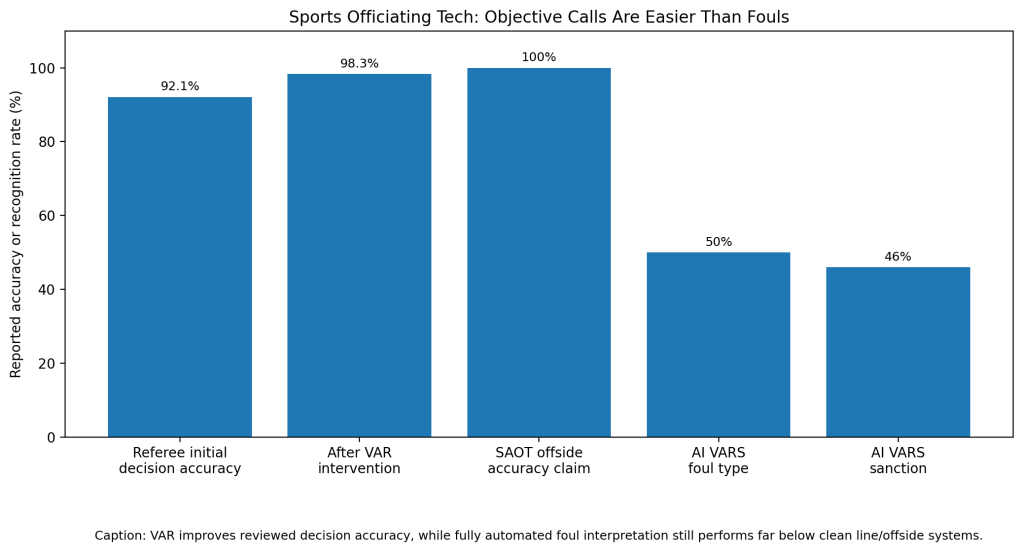
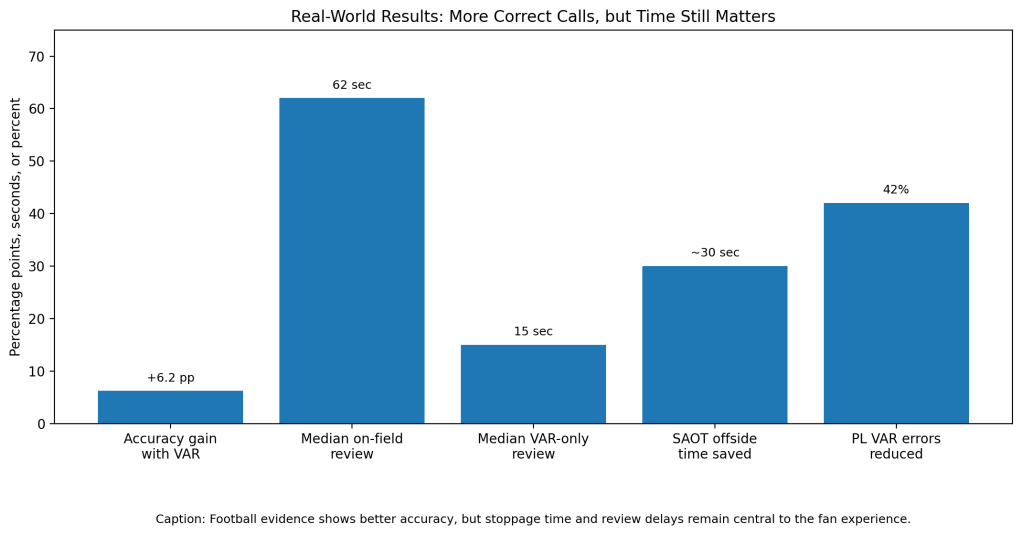
The evidence for decision support is strong. Spitz and colleagues studied 2,195 matches across 13 professional men’s national leagues and found that decision accuracy increased from 92.1% for the original on-field referee decision to 98.3% after VAR intervention. They also found median review times of 62 seconds for on-field reviews and 15 seconds for VAR-only reviews (Spitz et al.).
Semi-automated offside technology is even more data-heavy. FIFA says its system uses 16 dedicated stadium cameras to track the ball and players, typically 50 times per second, and generates automated offside alerts for the video match officials to review before a decision is communicated (FIFA).
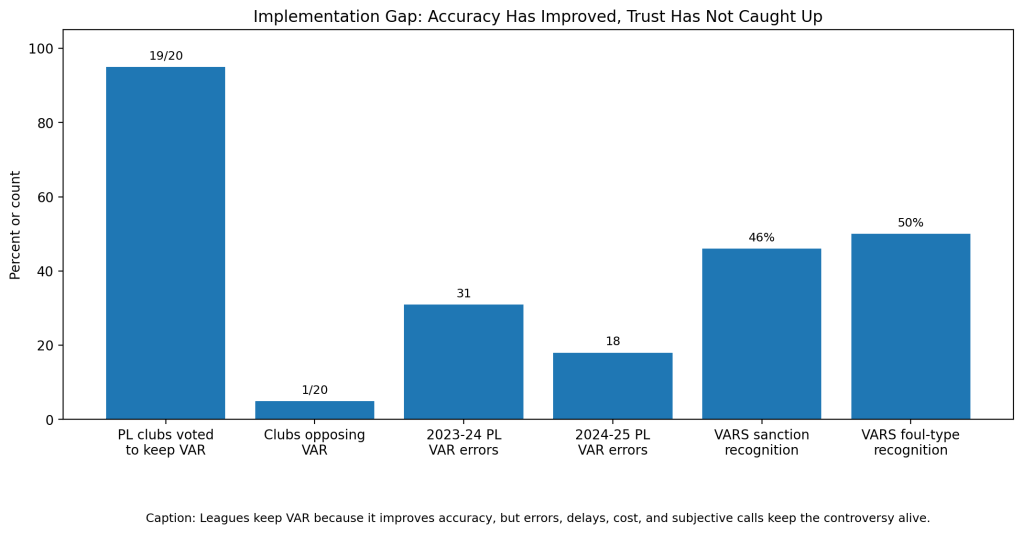
But not all officiating problems are the same. Automated line and offside decisions are easier than interpreting fouls. Held and colleagues’ 2024 AI-powered Video Assistant Referee System reached state-of-the-art results on SoccerNet-MVFoul, but still recognized foul type in only 50% of cases and the correct sanction in 46% of cases. That is promising research, not a replacement referee (Held et al.).
Section 3: What the Real World Shows
VAR has improved accuracy, but the live experience still struggles. Spitz’s multi-league study found accuracy rose by 6.2 percentage points after VAR intervention, but reviews also added stoppages. That tradeoff is the core tension: fans want correct calls, but they hate waiting without knowing what is happening (Spitz et al.).
Semi-automated offside is designed to reduce that pain. The Premier League says close offside decisions are expected to be about 30 seconds faster with SAOT. It also says offside calls in the league had been judged 100% correct that season, so the main improvement is speed and communication, not changing the law (Premier League).
The league-level numbers show why officials keep the system anyway. ESPN reported that Premier League VAR errors fell from 31 in 2023-24 to 18 in 2024-25, a 42% reduction. Reuters also reported that Premier League clubs voted 19-1 in June 2024 to keep VAR while asking for improvements to delays, fan experience, training, and transparency (ESPN; Reuters).
Section 4: The Implementation Gap
The first gap is subjectivity. A ball crossing a line is binary. A foul is not. Was there contact? Was it enough contact? Did the attacker exaggerate? Was it careless, reckless, or serious foul play? That is why current AI systems struggle more with foul type and sanctions than offside or goal-line decisions (Held et al.).
The second gap is delay. The same review that fixes a wrong decision can drain emotion from a goal celebration. Spitz and colleagues found a median of 62 seconds for on-field VAR reviews, which is long enough to change the rhythm of a match (Spitz et al.). Semi-automated offside helps, but it does not solve penalties, red cards, handballs, or subjective fouls.
The third gap is access. Held and colleagues write that VAR is mostly limited to professional leagues because the infrastructure is expensive and many federations lack enough referees. That means the highest levels of sport get the best technology, while lower levels still rely on humans with fewer camera angles and no replay room (Held et al.).
The fourth gap is communication. Reuters reported that the Premier League identified six improvement areas after the 2024 VAR vote, including reducing delays, improving fan experience, more training, more transparency, and a broader fan and stakeholder communication campaign. The problem is not only whether the decision is right. It is whether people understand why it was made (Reuters).
Section 5: Where It Actually Works
The technology works best for objective boundary decisions. Goal-line technology answers one question: did the ball fully cross the line? Offside technology answers another: was an attacking player in an offside position at the moment the ball was played? Those calls depend on geometry, timing, and calibration, which cameras and tracking systems handle well.
It works less cleanly when the sport asks for interpretation. Foul severity, intent, advantage, handball context, and “clear and obvious” error thresholds still require judgment. The best system keeps the referee as the decision-maker and uses data to reduce obvious mistakes.
Section 6: The Opportunity
The opportunity is not a robot referee. It is a better officiating stack: computer vision for line decisions, tracking data for offside, replay support for major errors, and clearer communication for fans inside the stadium and at home.
The next generation should focus less on showing off technology and more on making decisions understandable. Fast 3D replays, in-stadium explanations, published review standards, and calibrated thresholds would do more for trust than another black-box model. In sport, the call has to be right. But it also has to feel legitimate.
References
[1] FIFA. “FIFA World Cup Qatar 2022 Global Engagement & Audience Report.” 2023.
[2] Spitz, J., et al. “Video Assistant Referees (VAR): The Impact of Technology on Decision Making in Association Football Referees.” Journal of Sports Sciences, 2021.
[3] FIFA. “Semi-Automated Offside Technology.” FIFA Innovation, 2026.
[4] Held, Jan, et al. “Towards AI-Powered Video Assistant Referee System (VARS) for Association Football.” arXiv, 2024.
[5] Premier League. “Semi-Automated Offside Technology: What You Need to Know.” 2025.
[6] ESPN. “Every Premier League VAR Error: Winners and Losers, Referee Stats 2024-25.” 2025.
[7] Reuters. “Premier League Teams Vote to Keep VAR.” 2024.
[8] Martín-Moncunill, D. “Possibilities of Artificial Intelligence in Sports Refereeing.” Multimodal Technologies and Interaction, 2026.
[9] Kim, J. H., et al. “Ethical Implications of Artificial Intelligence in Sport.” Journal of Sport and Health Science, 2025.
[10] Dendir, S. “Did Technology Break the Game? Effects of the Video Assistant Referee on Football.” 2026.
 Aethel.
Leave a comment