Section 1: The Problem
Online reviews have become the new storefront. People use stars, photos, ratings, and written comments to decide where to eat, what to buy, which hotel to book, and which local business to trust. That system breaks when fake reviews push weak products and dishonest businesses above real ones.
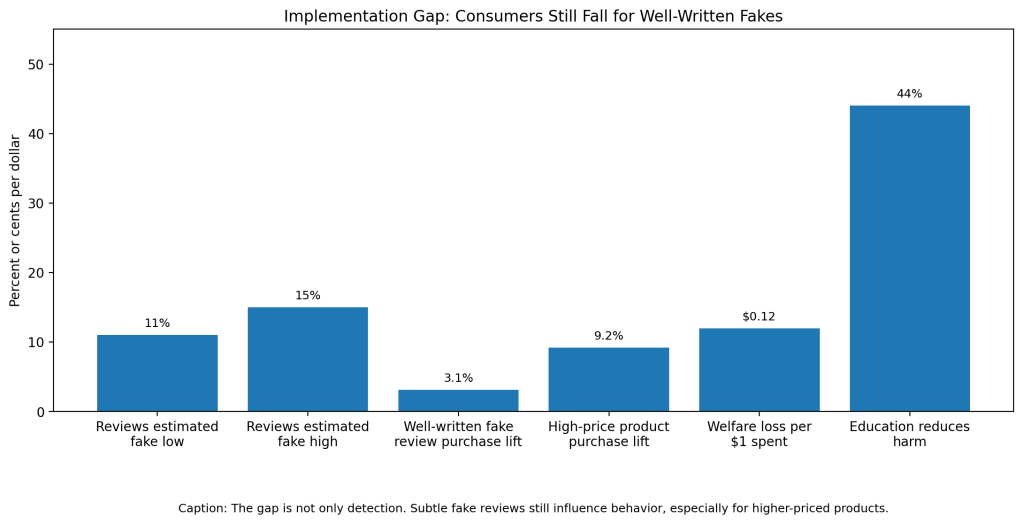
The damage is measurable. UK government research estimated that 11% to 15% of product reviews on e-commerce platforms are fake, and that well-written fake reviews make consumers more likely to buy the product (UK DBT). The same assessment cited estimates that fake reviews influence about $152 billion in online spending globally and cause up to £312 million in annual UK consumer detriment from fake review text alone (UK DBT).
The FTC responded with a final rule banning fake reviews and testimonials. The rule prohibits buying or selling fake reviews, insider reviews without disclosure, review suppression, fake independent review sites, and fake social media influence indicators (FTC).
Section 2: What Research Shows
Fake review detection works because fake reviews leave patterns. Models look at language, timing, reviewer history, account relationships, rating bursts, seller behavior, and suspicious coordination. Newer systems use transformers because fake reviews often sound normal at the sentence level.
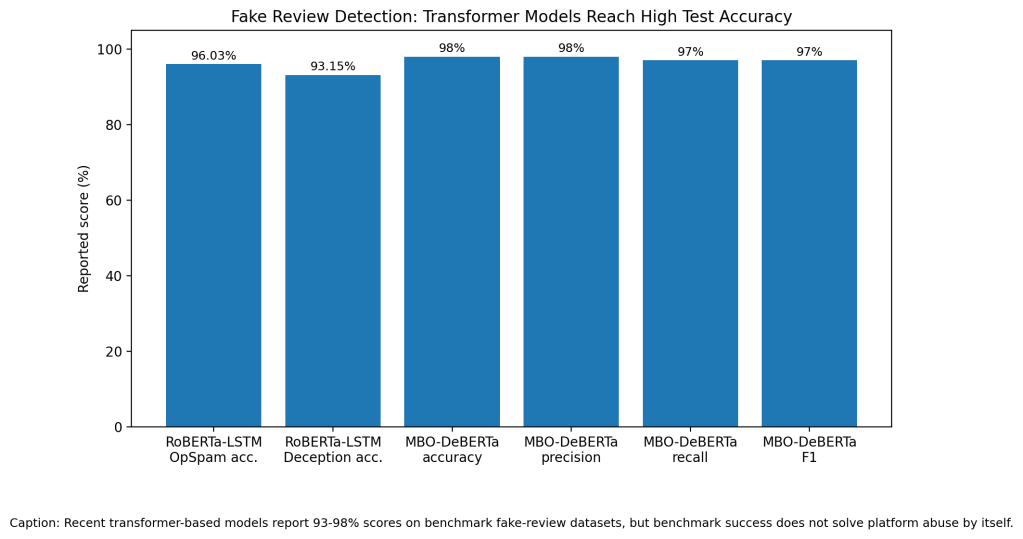
Mohawesh and colleagues built a transformer-based RoBERTa-LSTM model and tested it on fake-review benchmark datasets. It reached 96.03% accuracy on the OpSpam dataset and 93.15% accuracy on the Deception dataset (Mohawesh et al.).
Geetha and colleagues tested MBO-DeBERTa on Amazon, Fake Review, and Deceptive Opinion Spam datasets totaling 21,000, 40,000, and 1,600 reviews. Their model reached 98% accuracy, 98% precision, 97% recall, and 97% F1 score (Geetha et al.). A 2024 Cambridge review still warned that fake review research struggles with limited training data, cross-dataset inconsistency, concept drift, and new fake-review tactics (Gupta et al.).
Section 3: What the Real World Shows
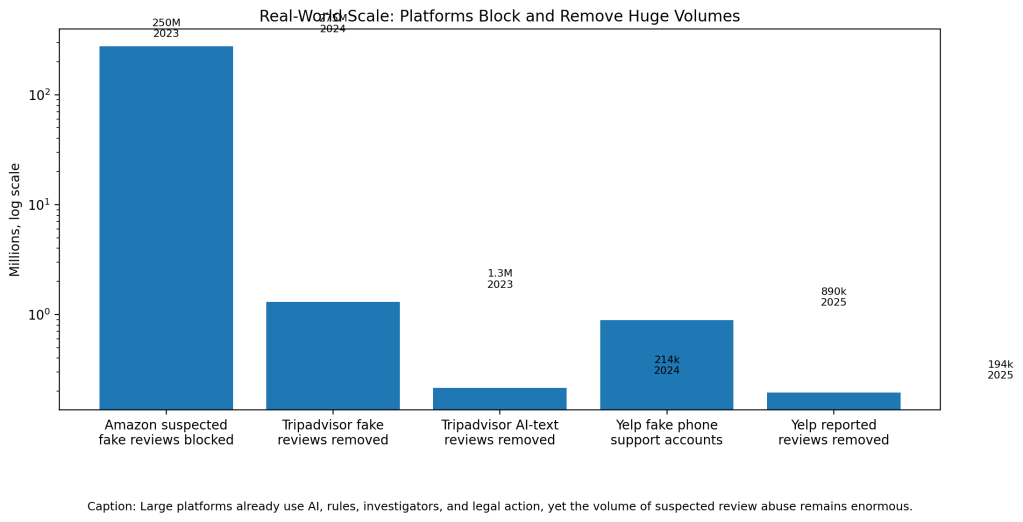
The platforms already use large-scale detection. Amazon says its machine learning models analyze account relationships, sign-in patterns, review history, risky behavior, and other signals before reviews publish. In 2024, Amazon proactively blocked over 275 million suspected fake reviews from its store (Amazon).
Tripadvisor reported 1.3 million fake reviews identified and removed in 2023, with 72% caught before posting (Tripadvisor). Its 2025 report said the platform removed more than 214,000 reviews in 2024 that it believed contained AI-generated text, across 101,411 properties in 189 countries (Tripadvisor).
Yelp’s 2025 Trust & Safety Report shows the problem has moved beyond normal fake stars. Yelp removed over 193,700 reported reviews, closed more than 1.3 million accounts for Terms of Service violations, removed more than 889,800 fake phone-support accounts tied to airline scams, and rejected more than 50,700 potential business pages associated with spammy behavior (Yelp).
Section 4: The Implementation Gap
The first gap is that benchmark accuracy does not equal platform accuracy. A model that reaches 98% on a clean dataset can fail when scammers change style, generate reviews with AI, use real accounts, add photos, or coordinate across third-party groups. Gupta’s 2024 review names concept drift and inconsistent performance across datasets as major limitations (Gupta et al.).
The second gap is that fake reviews still change behavior. Akesson and colleagues ran an incentive-compatible experiment with 10,000 UK consumers on a shopping platform resembling Amazon. Inflated star ratings made consumers 5.8 percentage points more likely to choose a low-quality “Don’t Buy” product, and fake written reviews increased the effect further. The authors estimated welfare losses around $0.12 per dollar spent in their platform setting (Akesson et al.).
The third gap is subtlety. UK government research found poorly written fake reviews made consumers 5.3% less likely to purchase a product, but well-written fake reviews made them 3.1% more likely to purchase it. For products over £80, subtle fake reviews made consumers 9.2% more likely to purchase (UK DBT).
The fourth gap is enforcement outside the platform. Amazon says fake review brokers operate through websites, social channels, encrypted messaging, and coordinated refund schemes. Amazon and Google filed parallel lawsuits against one fake review site in 2024, while Amazon said it took legal action against more than 150 bad actors in 2023 (Amazon).
Section 5: Where It Actually Works
Fake review detection works best before publication. Amazon’s system blocks reviews before customers see them when confidence is high, then sends suspicious cases to trained investigators when more evidence is needed (Amazon). That matters because a review removed after it misleads buyers has already done damage.
It also works best when detection combines platform data and law enforcement. Yelp uses user reports, business-owner reports, automated detection, human investigations, consumer alerts, account closures, and reports to other platforms where paid-review groups operate (Yelp). Amazon uses machine learning, investigators, lawsuits, and industry partnerships (Amazon).
Section 6: The Opportunity
The opportunity is not to make every review disappear into an algorithm. It is to make review systems harder to manipulate and easier to trust.
The next step is layered review integrity: pre-publication screening, behavioral graph detection, review-broker takedowns, visible consumer alerts, seller penalties, and clear appeals for legitimate reviewers. Platforms also need to measure false positives because blocking a real customer review can harm honest businesses.
The best future system will treat fake reviews like fraud, not bad grammar. It will look at who wrote the review, when it appeared, what the account did before, how the seller behaved, and whether the same network is manipulating other platforms too.
References
[1] Federal Trade Commission. “Federal Trade Commission Announces Final Rule Banning Fake Reviews and Testimonials.” 2024.
[2] UK Department for Business and Trade. Measures to Address Fake Online Reviews: Impact Assessment. 2023.
[3] Akesson, Jesper, et al. “The Impact of Fake Reviews on Demand and Welfare.” NBER Working Paper No. 31836, 2023.
[4] Mohawesh, Rami, et al. “Fake Review Detection Using Transformer-Based Enhanced LSTM and RoBERTa.” Journal of Innovative Digital Transformation, 2024.
[5] Geetha, S., et al. “High Performance Fake Review Detection Using Pretrained DeBERTa Optimized with Monarch Butterfly Paradigm.” Scientific Reports, 2025.
[6] Gupta, R., et al. “Recent State-of-the-Art of Fake Review Detection: A Comprehensive Review.” The Knowledge Engineering Review, 2024.
[7] Amazon. “Amazon’s Latest Actions Against Fake Review Brokers.” 2025.
[8] Amazon. “How Amazon Is Using AI to Detect Fake Product Reviews and Ensure Authentic Customer Feedback.” 2024.
[9] Tripadvisor. “Transparency Report 2023.” 2024.
[10] Yelp. “Yelp Releases 2025 Trust & Safety Report.” 2026.
 Aethel.
Leave a comment