Section 1: The Problem
Space weather sounds distant until it breaks something on Earth. Solar flares, coronal mass ejections, and geomagnetic storms can disrupt GPS, satellites, radio communication, aviation systems, and power-grid equipment. NOAA says geomagnetic storms can induce currents in electric grids, damage transformers, and cause long-term disruptions to power distribution. It also says solar activity can distort or interrupt GPS signals used in shipping, military systems, drones, space operations, and resource extraction.
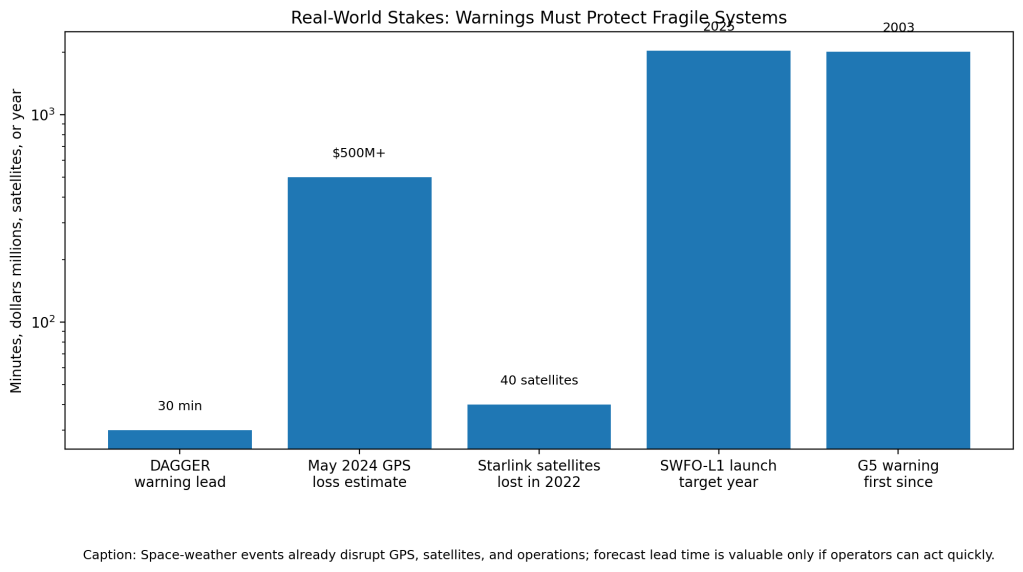
The May 2024 Gannon storm showed the risk clearly. NOAA reported that GPS outages during a crucial planting period cost American farmers more than $500 million in potential profit. That same event was a G5 geomagnetic storm, the highest NOAA category, and one of the strongest storms in decades.
Traditional space weather forecasting depends on solar observatories, satellites at Lagrange Point 1, magnetometers, expert forecasters, and physics-based models. The problem is timing. A warning only matters if operators can act before satellites lose orientation, GPS becomes unreliable, or grid equipment absorbs dangerous currents.
Section 2: What Research Shows
Machine learning can improve space weather forecasting because the data is complex, fast, and nonlinear. NASA’s DAGGER model uses AI and NASA satellite data to analyze solar wind measurements and predict where an incoming solar storm may strike on Earth with about 30 minutes of advance warning. NASA describes it as a possible “tornado siren” for solar storms.
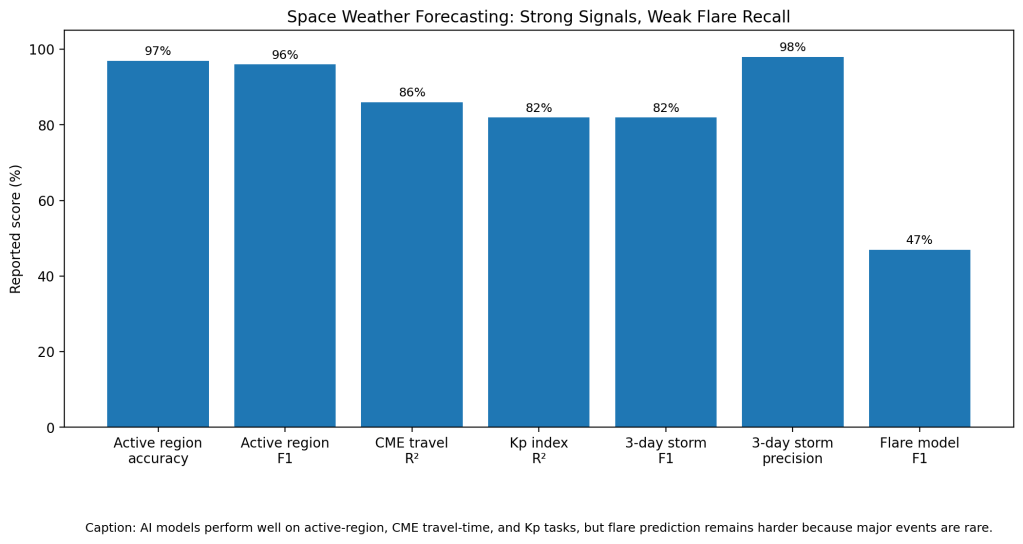
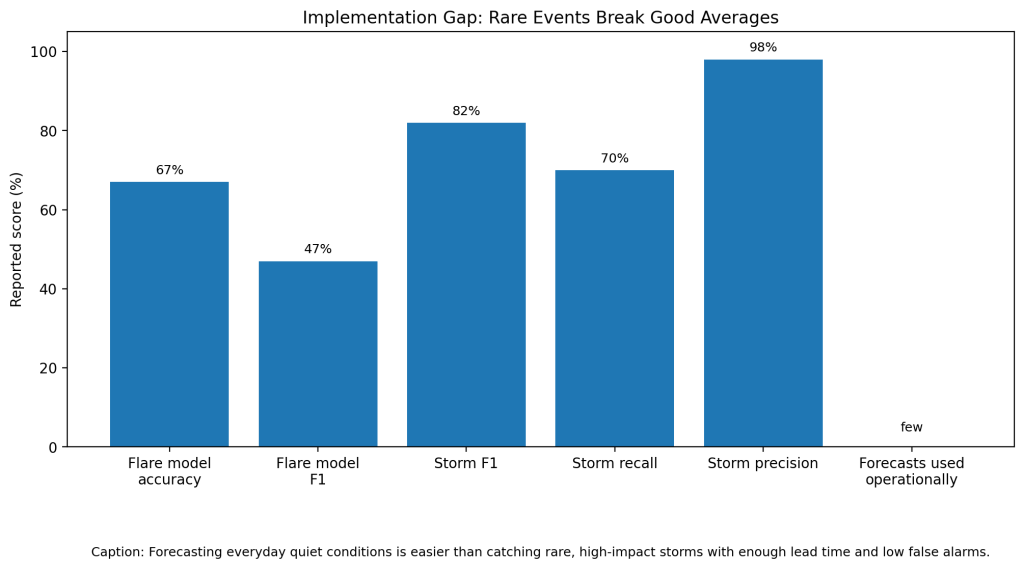
Recent AI models show strong retrospective performance on some tasks. Shirke and Parihar’s 2025 AI-based space weather system reported 0.97 accuracy and 0.96 F1 for solar active-region classification. It also reported R² = 0.86 with 1.52-hour RMSE for CME travel-time prediction, R² = 0.82 with 0.63 RMSE for Kp-index prediction, and 0.999 accuracy with 0.87 F1 for satellite risk classification. The weak point was solar flare prediction, where the CNN-LSTM model reached only 0.67 accuracy and 0.47 F1 because flare events are rare and imbalanced.
Wang and colleagues tested a machine-learning model for the next three-day Kp forecast. For storm periods with maximum Kp ≥ 5, the model reached 0.82 F1, 0.70 recall, and 0.98 precision. For non-storm periods, it reached 0.96 F1. That gap matters because quiet space weather is easier to forecast than rare damaging storms.
Section 3: What the Real World Shows
The real-world value is preparation time. NOAA’s Space Weather Prediction Center issues alerts, watches, and warnings, similar to National Weather Service bulletins, so the public and operators know what space weather conditions to expect. Those products cover GPS, power transmission, HF radio, satellite communications, and satellite drag.
NASA’s DAGGER model points toward a more targeted version of that system. Instead of only warning that a storm is coming, it aims to predict where on Earth the strongest geomagnetic disturbance will strike with 30 minutes of lead time. That lead time could let grid operators shift loads, satellite operators delay maneuvers, radio operators adjust frequencies, and aviation systems prepare alternate procedures.
NOAA is also expanding the observing system. Its SWFO-L1 mission, planned for launch in fall 2025, is designed to improve monitoring from Lagrange Point 1, where solar-wind measurements can give warning before space weather reaches Earth. NOAA says these next-generation capabilities are needed because satellite dependence keeps growing.
Section 4: The Implementation Gap
The first gap is rare-event prediction. A model can look accurate overall but still miss the events that matter most. Shirke and Parihar’s system reached 0.67 accuracy on flare prediction but only 0.47 F1, partly because the model handled quiet-class events better than flare events. In space weather, the rare class is often the dangerous class.
The second gap is false alarms. Operators cannot shut down, delay, reroute, or safe-mode systems every time a model sees risk. A bad alert wastes money and can make users ignore the next warning. NOAA’s warning system works because it uses severity levels, but AI outputs still need calibration, confidence scores, and human forecaster review before they trigger costly action.
The third gap is operational integration. Shirke and Parihar describe future work that still needs real-time satellite feeds, deployment on satellites or ground stations, and integration with satellite-control systems for autonomous responses. That means the model is not the whole solution. The warning must connect to real machines and real procedures.
The fourth gap is measurement coverage. Space weather forecasts depend heavily on upstream solar-wind observations. NOAA’s SWFO-L1 investment shows that better algorithms still need better instruments. Without reliable data, even a strong model is guessing.
Section 5: Where It Actually Works
Space weather forecasting works best when the action is simple and preplanned. A satellite operator can move a spacecraft into safe mode. A grid operator can monitor vulnerable transformers. Aviation and radio users can prepare for HF communication degradation. NOAA’s current alert system already organizes warnings by expected impacts, which makes them easier to act on.
AI works best as a faster layer inside that system. It can scan solar-wind data, update predictions quickly, and flag where a disturbance may hit hardest. Human forecasters and operators still need to decide when the risk is high enough to act.
Section 6: The Opportunity
The opportunity is not predicting the Sun perfectly. It is turning noisy solar data into enough warning for fragile infrastructure to protect itself.
The next step is operational trust. Space weather AI needs better rare-event recall, lower false-alarm rates, clear uncertainty, live data feeds, and playbooks for satellites, GPS-dependent industries, grid operators, and aviation users. The Sun will keep erupting. The goal is to make sure Earth’s technology is not surprised.
References
[1] NOAA NESDIS. “Safeguarding Satellites: How NOAA Monitors Space Weather to Prevent Disruptions.” 2025.
[2] NASA. “NASA-enabled AI Predictions May Give Time to Prepare for Solar Storms.” 2023.
[3] Shirke, Rachana Ramesh, and Veena Parihar. “AI-Based Space Weather Prediction for Satellite Protection.” ISPRS Annals, 2025.
[4] Wang, J., et al. “A Machine Learning-Based Model for the Next 3-Day Geomagnetic Index (Kp) Forecast.” Frontiers in Astronomy and Space Sciences, 2023.
[5] NOAA Space Weather Prediction Center. “Alerts, Watches and Warnings.” 2026.
[6] Camporeale, E., et al. “Verification of the NOAA Space Weather Prediction Center Probabilistic Flare Forecasts, 1998–2024.” Space Weather, 2025.
[7] Upendran, V., et al. “Global Geomagnetic Perturbation Forecasting Using Deep Learning.” Space Weather, 2022.
[8] Parker, W. E., et al. “Satellite Drag Analysis During the May 2024 Gannon Geomagnetic Storm.” Journal of Spacecraft and Rockets, 2024.
[9] Yang, Z., et al. “Impacts of the May 2024 Extreme Geomagnetic Storm on GPS Precise Point Positioning.” Space Weather, 2025.
[10] Huang, X., et al. “Short-Term Solar Eruptive Activity Prediction Models Based on Machine Learning: A Review.” 2024.


Leave a Reply