Section 1: The Problem
The phone network was built for reach, not suspicion. That worked when most calls came from known homes, offices, and switchboards. It fails when scammers can spoof numbers, rotate carriers, generate voices, and make millions of calls at low cost.
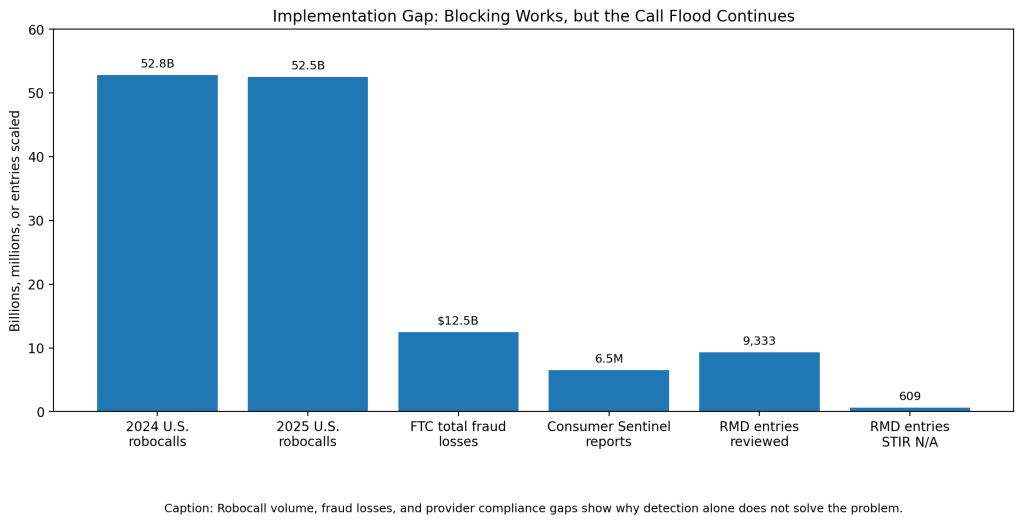
The scale is still huge. YouMail reported 52.8 billion U.S. robocalls in 2024 and 52.5 billion in 2025, keeping annual volume near the 50-55 billion range (YouMail). FTC’s 2024 Consumer Sentinel Data Book recorded 6.5 million consumer reports across fraud, identity theft, and other consumer issues (FTC).
The harm is not just annoyance. FTC reported more than $12.5 billion in fraud losses in 2024, up from 2023, and the share of fraud reporters who lost money rose from 27% to 38% (FTC). Phone scams are especially damaging because callers create pressure in real time. PIRG reported a median loss of $1,480 for scam phone calls in 2024 (PIRG).
Section 2: What Research Shows
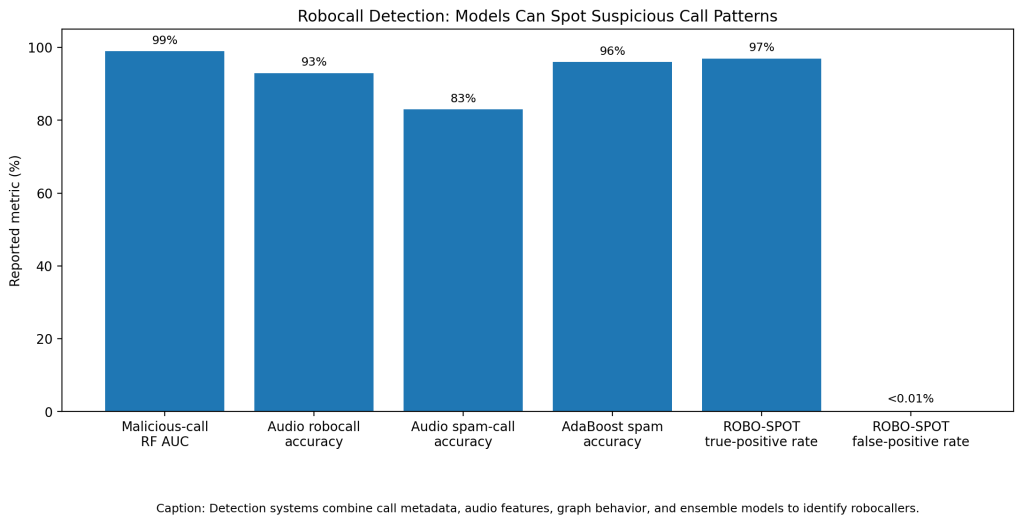
Robocall detection works best when it uses more than one signal. Models can examine call detail records, call duration, caller history, answer patterns, reputation networks, complaint patterns, and audio features. That matters because a scammer can change a number, but it is harder to hide behavior across many calls.
ROBO-SPOT used more than 1 billion anonymized call records collected over 10 days from a large telecom provider. The system classified callers using trust features and machine learning, reaching about a 97% true-positive rate with a false-positive rate below 0.01% (Azad et al.).
Audio-based detection also works. Elizalde and Emmanouilidou used acoustic features from voicemails to distinguish human calls from robocalls and spam from non-spam. Their approach reached 93% accuracy for human-versus-robocall detection and 83% accuracy for spam-versus-non-spam detection (Elizalde and Emmanouilidou).
Section 3: What the Real World Shows
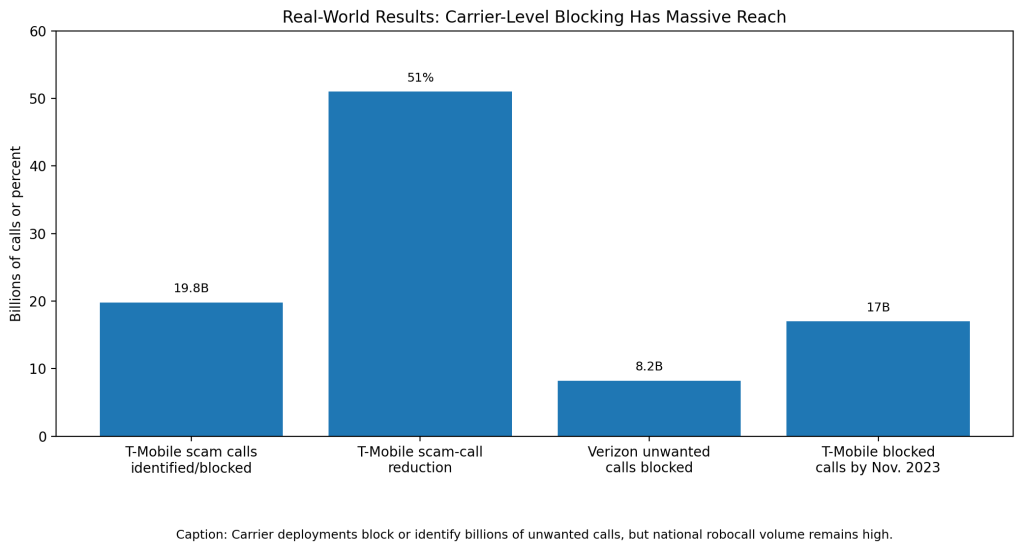
Carrier-level tools already operate at massive scale. T-Mobile said Scam Shield identified or blocked 19.8 billion scam calls in 2023, equal to 628 scam calls per second. The company also reported a 51% decrease in scam calls from 2022, citing network technology, machine learning, AI, and broader government intervention (T-Mobile).
T-Mobile also reported that by November 2023, Verizon had blocked 8.2 billion unwanted calls while T-Mobile had blocked 17 billion. Those numbers show the strength of network-level filtering: the best defense happens before the phone rings (T-Mobile).
Caller ID authentication adds another layer. FCC’s STIR/SHAKEN framework focuses on stopping spoofed caller ID by requiring providers to authenticate calls and run robocall mitigation programs (FCC). It does not decide whether every call is safe, but it gives carriers a better signal when a number is being faked.
Section 4: The Implementation Gap
The first gap is adaptation. Scammers change numbers, routes, scripts, timing, and identities. T-Mobile’s 2023 report said scammers shift tactics seasonally, target different regions, and increasingly use AI-driven tools such as synthetic voice and voice cloning (T-Mobile).
The second gap is false positives. Blocking a scam call helps. Blocking a doctor, school, bank, employer, or emergency follow-up call creates a different problem. T-Mobile’s own Scam Shield notice says turning on Scam Block might block calls users want, which shows why carriers often label calls instead of silently dropping every risky one (T-Mobile).
The third gap is network compliance. EPIC reviewed the FCC Robocall Mitigation Database in October 2024 and found 9,333 total entries, including 609 entries listing STIR/SHAKEN implementation as “N/A” and 601 entries missing a contact phone number. Even if those entries are a minority, weak records make enforcement harder (EPIC).
The fourth gap is that authentication is not the same as trust. FCC’s 2025 proposal said STIR/SHAKEN made spoofing harder and improved call blocking and labeling, but the agency still proposed stronger verified caller-name requirements so consumers could better decide whether to answer (FCC).
Section 5: Where It Actually Works
Robocall detection works best when carriers combine layers. Caller authentication helps identify spoofing. Network analytics catch high-volume suspicious behavior. User reports improve reputation systems. Audio or transcript models can help with voicemail and scam scripts.
It also works best when users still control the final risk level. A call can be authenticated, labeled “scam likely,” sent to voicemail, blocked by user preference, or blocked at the network level. That layered design protects people while reducing the chance of cutting off important calls.
Section 6: The Opportunity
The opportunity is not one perfect spam-call model. It is a cleaner phone network where suspicious calls lose speed, reach, and believability before they hit real people.
The next step is stronger real-time coordination. Carriers need faster traceback, better shared reputation signals, verified business identity, stricter mitigation database enforcement, and clear user controls. The phone should still ring when it matters. It should not ring because a scammer bought another path through the network.
References
[1] Federal Trade Commission. Consumer Sentinel Network Data Book 2024. 2025.
[2] Federal Trade Commission. “New FTC Data Show a Big Jump in Reported Losses to Fraud to $12.5 Billion in 2024.” 2025.
[3] YouMail. “U.S. Consumers Received 52.5 Billion Robocalls in 2025.” 2026.
[4] PIRG Education Fund. Ringing in Our Fears 2024. 2024.
[5] Azad, Muhammad Ajmal, Junaid Arshad, and Farhan Riaz. “ROBO-SPOT: Detecting Robocalls by Understanding User Engagement and Connectivity Graph.” Big Data Mining and Analytics, 2024.
[6] Elizalde, Benjamin, and Dimitra Emmanouilidou. “Detection of Robocall and Spam Calls Using Acoustic Features of Incoming Voicemails.” Proceedings of Meetings on Acoustics, 2021.
[7] Gupta, Sandeep. “A Review on Real-Time Suspicious Call Detection Systems in Telecom Networks.” Journal of Computer Science and Information Technology, 2025.
[8] T-Mobile. “T-Mobile Report: Customers Protected from Over 19 Billion Scam Calls in 2023.” 2024.
[9] Federal Communications Commission. “Combating Spoofed Robocalls with Caller ID Authentication.” 2026.
[10] Electronic Privacy Information Center. “Improving the Effectiveness of the Robocall Mitigation Database.” 2024.


Leave a Reply