Section 1: The Problem
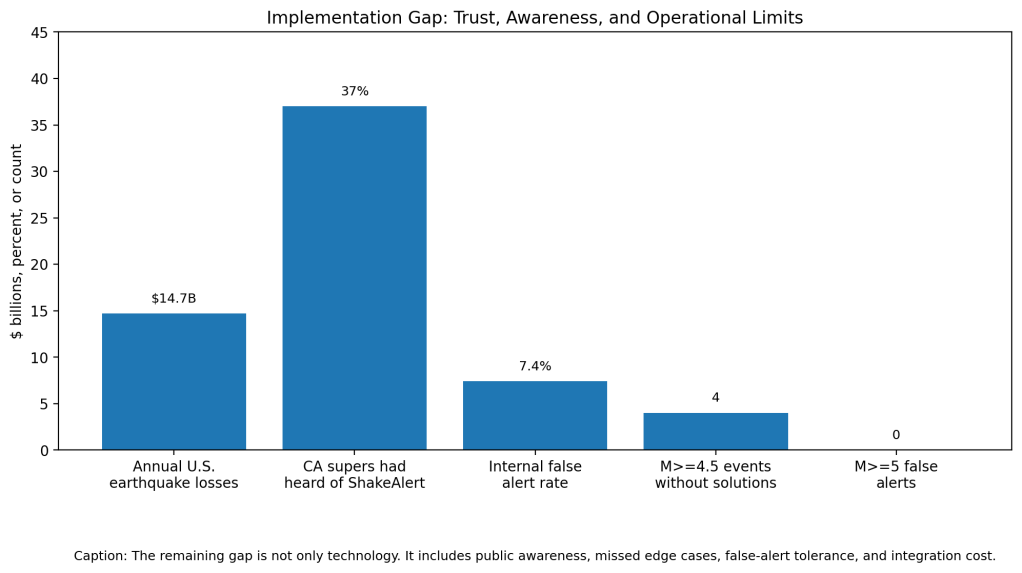
Earthquakes cannot be predicted before they start, but shaking can be detected fast enough to warn people farther from the epicenter. That difference matters. USGS and FEMA estimate earthquakes cost the United States about $14.7 billion each year in building damage and related losses (Jaiswal et al.).
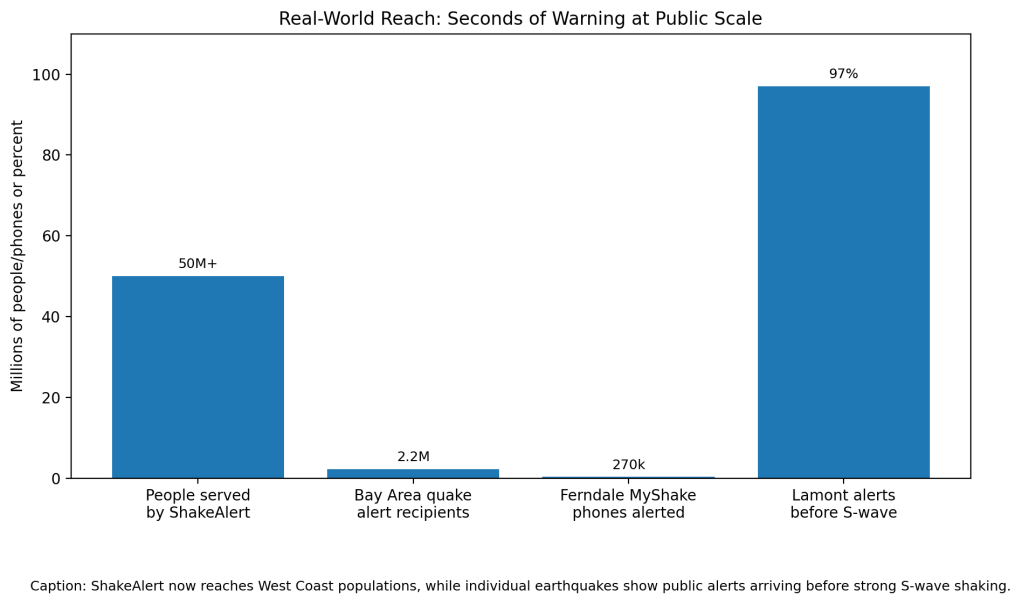
The U.S. West Coast now has ShakeAlert, the nation’s public earthquake early warning system. It serves more than 50 million residents and visitors in California, Oregon, and Washington by detecting significant earthquakes and sending alerts before strong shaking arrives (USGS).
Traditional earthquake response begins after shaking starts. People duck late. Trains slow late. Schools react after furniture is already moving. Early warning systems change the timing. A few seconds can let people drop, cover, hold on, open fire station doors, slow machinery, pause surgeries, or stop elevators at the next floor.
Section 2: What Research Shows
Earthquake early warning is a data problem built on speed. Sensors detect the fast, weaker P-waves first. Algorithms estimate location, magnitude, and expected shaking before slower, stronger waves arrive. USGS describes ShakeAlert as a system that identifies earthquake rupture, estimates shaking intensity, and sends alerts to people or automated systems that may feel shaking (USGS).
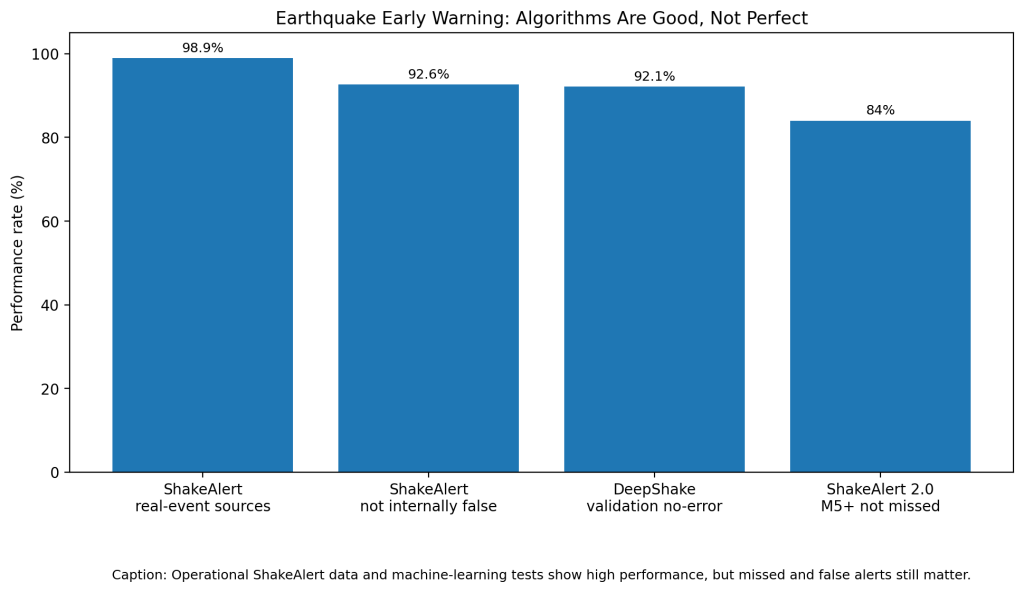
ShakeAlert’s recent operational record is strong, but not perfect. From October 17, 2019 to September 1, 2023, it created 95 source events at the M 4.5 public-alert threshold. Ninety-four came from real earthquakes. Seven were classified as “false” under internal rules, although all but one were real earthquakes with poor locations near network edges (Lux et al.).
Machine learning may improve the next generation. DeepShake trained on 28,543 Ridgecrest earthquake events and reached a 7.9% equal error rate when asked to alert for MMI III+ shaking at least five seconds ahead on 3,568 validation earthquakes (Datta et al.). EEWNet used 30,756 accelerograms from 688 Japanese KiK-net borehole sensors and estimated magnitude from the first 0.5 to 3 seconds of P-wave data better than the traditional peak displacement method (Wang et al.).
Section 3: What the Real World Shows
The strongest real-world evidence comes from public alerts already delivered. During the October 2022 Bay Area earthquake, California reported that 2.2 million people received emergency notifications up to 19 seconds before shaking began. Android users received about 2.1 million alerts, and MyShake users received about 95,000 alerts (California Governor’s Office).
During the December 2022 Ferndale earthquake, MyShake delivered alerts to more than 270,000 phones across the shaking region (Allen). For the 2024 Lamont earthquake near Bakersfield, MyShake sent alerts to more than half a million phones, and 97% of those phones received the warning before the S-wave arrived (Allen).
These are not abstract model scores. They are real alerts reaching real people before shaking. The system still cannot help someone sitting directly on top of the epicenter, but it can help people farther away who have seconds to act.
Section 4: The Implementation Gap
The first gap is false-alert trust. Lux and colleagues found a 7.4% internal false-alert rate for M 4.5 or larger ShakeAlert source events from 2019 to 2023. The system produced no M 5 or larger false alerts during that period, but even small false or unnecessary alerts can damage public confidence if people feel warned for no reason (Lux et al.).
The second gap is missed edge cases. ShakeAlert missed four ComCat M 4.5 or larger events because they occurred near the edge of the alerting and network boundaries. Three detected events were also labeled missed because their location error exceeded 100 kilometers (Lux et al.). This shows why sensor coverage matters. Sparse edges make fast location harder.
The third gap is institutional adoption. A 2024 study of school districts in Alaska, California, Oregon, and Washington found superintendents had low awareness of ShakeAlert, even though they saw strong potential for life-saving protective actions. The study identified implementation and maintenance cost as a major barrier (Adams et al.).
The fourth gap is expectations. Bostrom and colleagues found public expectations and perceived usefulness were high, but people’s alert-threshold preferences did not always match how government and scientists set the system. If people expect warnings for weaker shaking than the system sends, they may think it failed even when it operated as designed (Bostrom et al.).
Section 5: Where It Actually Works
Earthquake early warning works best when it triggers simple actions. Phones should tell people to drop, cover, and hold on. Schools should play automatic public-address alerts. Rail systems and industrial facilities should use machine-to-machine triggers for actions that do not require debate.
The Stanwood-Camano School District in Washington gives a practical example. Its ShakeAlert school case study describes a districtwide system that sends alerts through public-address systems so students and staff can drop, cover, and hold on before shaking reaches them (ShakeAlert).
The best implementations do not ask people to interpret complex science in the moment. They turn a few seconds into one clear behavior.
Section 6: The Opportunity
The opportunity is not earthquake prediction. It is faster detection, better public alerts, and automatic protective action before shaking arrives. The technology already works well enough to reach millions, but the next step is trust.
That means better edge-network coverage, clearer public education, fewer unnecessary alerts, and more integrations in schools, utilities, factories, hospitals, and rail systems. Earthquake early warning will never stop the ground from moving. It can make sure people and systems move first.
References
[1] Jaiswal, Kishor S., et al. Hazus Estimated Annualized Earthquake Losses for the United States. FEMA and USGS, 2023.
[2] U.S. Geological Survey. “ShakeAlert: Because Seconds Matter.” 2026.
[3] Lux, A. I., et al. “Status and Performance of the ShakeAlert Earthquake Early Warning System: 2019-2023.” Bulletin of the Seismological Society of America, 2024.
[4] Datta, Animesh, et al. “DeepShake: A Machine-Learning Approach for Earthquake Early Warning.” Seismological Society of America, 2021.
[5] Wang, Yanwei, Xiaojun Li, Zifa Wang, and Juan Liu. “Deep Learning for Magnitude Prediction in Earthquake Early Warning.” Gondwana Research, 2023.
[6] Navarro-Rodríguez, Andrés, et al. “Recent Advances in Early Earthquake Magnitude Estimation by Using Machine Learning Algorithms: A Systematic Review.” Applied Sciences, 2025.
[7] California Governor’s Office. “California’s First-In-The-Nation Earthquake Warning System Notified 2.2 Million People of Bay Area Quake.” 2022.
[8] Allen, Richard. “Earthquake Early Warning Milestones.” Berkeley Seismology Lab, 2024.
[9] Adams, Rachel M., et al. “ShakeAlert and Schools: Incorporating Earthquake Early Warning in School Districts in Alaska, California, Oregon, and Washington.” International Journal of Disaster Risk Reduction, 2024.
[10] Bostrom, Ann, et al. “Great Expectations for Earthquake Early Warnings on the United States West Coast.” International Journal of Disaster Risk Reduction, 2022.


Leave a Reply