Section 1: The Problem
Asteroid impacts are rare, but the damage can be sudden. In 2013, the Chelyabinsk meteor exploded over Russia with energy equivalent to about 440,000 tons of TNT, damaged buildings across 200 square miles, and injured more than 1,600 people, mostly from broken glass (NASA).
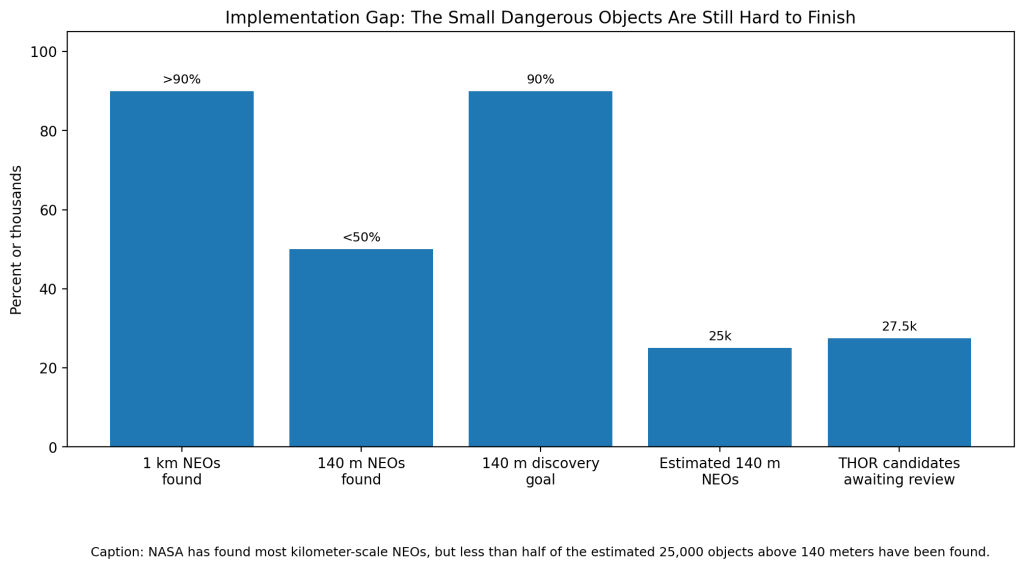
The larger danger is not the asteroid we already know about. It is the one still hidden in telescope data. NASA says more than 90% of near-Earth objects larger than 1 kilometer have been discovered, but less than half of the estimated 25,000 near-Earth objects larger than 140 meters have been found (NASA CNEOS, NASA NEO Observations).
Traditional asteroid discovery depends on telescopes taking repeated images, software linking moving dots, and humans confirming that the pattern is real. That works, but the sky produces massive data. Asteroids are faint, fast, and easy to confuse with noise, stars, satellite streaks, or image artifacts.
Section 2: What Research Shows
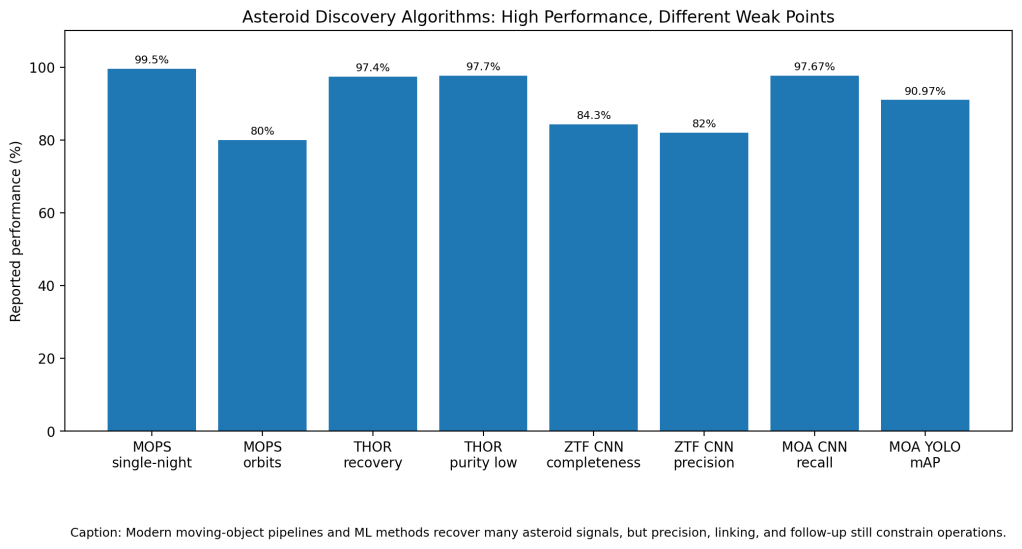
Data science improves asteroid discovery by linking weak signals across time. The older Pan-STARRS Moving Object Processing System, or MOPS, stayed more than 99.5% efficient at detecting objects on a single night, but dropped to about 80% efficiency at producing multi-night orbits (Denneau et al.).
THOR, short for Tracklet-less Heliocentric Orbit Recovery, changes the search method. Instead of requiring tightly timed same-night tracklets, it links observations across flexible cadences. In a two-week Zwicky Transient Facility test, THOR recovered 97.4% of known discoverable objects with five or more observations and reached 97.7% to 100% purity (Moeyens et al.).
Deep learning helps too. A 2025 CNN pipeline for near-Earth asteroid streaks in ZTF data reached 0.843 completeness and 0.820 precision on real survey images (Irureta-Goyena et al.). A 2023 MOA microlensing-survey study used CNNs and YOLOv4 to find asteroid tracklets, reaching 97.67% recall and 90.97% mAP (Cowan et al.).
Section 3: What the Real World Shows
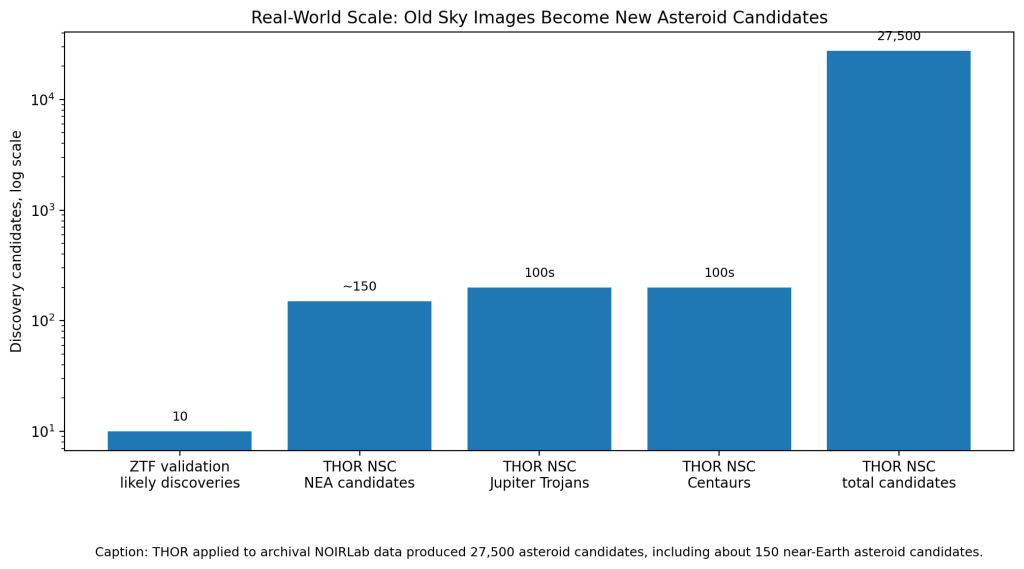
The strongest real-world example is THOR running on archival telescope data. The Asteroid Institute applied THOR to the NOIRLab Source Catalog Data Release 2 and identified more than 27,500 asteroid candidates, including about 150 near-Earth asteroid candidates, plus hundreds of Jupiter Trojans and Centaurs (Asteroid Institute).
This is the key point. The discoveries did not require a new telescope. They came from old sky images that were not originally designed for asteroid discovery. That turns archived astronomy into a second survey of the solar system.
Google Cloud reported that the system analyzed 5.4 billion observations in BigQuery and used cloud computing for massive asteroid-discovery workloads. It also noted that candidate verification remains a bottleneck because volunteers, students, scientists, and astronomers still review likely candidates by hand (Google Cloud).
Section 4: The Implementation Gap
The first gap is confirmation. A model can flag thousands of candidates, but those candidates need orbit quality checks, image review, follow-up observations, and submission to the Minor Planet Center. The Asteroid Institute says many THOR candidates have short observation arcs under one week, which makes their orbits uncertain until further review (Asteroid Institute).
The second gap is false signal overload. Pan-STARRS MOPS was designed to handle false detection rates equal to real-object rates, but in practice it could face 10 to 20 times higher false detection rates (Denneau). That means better algorithms still need strong filtering, not just more sensitivity.
The third gap is coverage. NASA’s goal is to find, track, and characterize at least 90% of NEOs 140 meters and larger, but less than half of the estimated 25,000 have been found so far (NASA NEO Observations). Until that gap closes, planetary defense remains incomplete.
The fourth gap is risk communication. Asteroid 2024 YR4 showed why uncertainty is hard to explain. NASA said its impact probability peaked above 3% on February 18, 2025, then dropped well under 1% as new data improved the orbit (NASA Science). That was not a mistake. That is how early orbit uncertainty works. But to the public, changing numbers can look like confusion.
Section 5: Where It Actually Works
These systems work best when they expand existing astronomy instead of replacing it. THOR works because it searches old data in a new way. CNNs work because they help reduce the number of streak candidates humans must inspect. The best workflow is model first, human confirmation second, telescope follow-up third.
Machine learning also helps after discovery. Chomette, Wheeler, and Mathias trained models to predict local asteroid damage zones using NASA’s Probabilistic Asteroid Impact Risk model as a reference. Their machine learning models predicted large damage-radius outcomes with less than 10% average relative error while cutting runtime enough to simulate millions of scenarios within minutes on a local computer (Chomette et al.).
Section 6: The Opportunity
The opportunity is not a movie-style asteroid alarm. It is a better map of the objects already crossing Earth’s neighborhood. Data science can search old images, connect faint dots across nights, rank candidates, estimate orbits, and run faster impact-risk simulations.
The next step is operational trust. Planetary defense needs better candidate verification, more automated quality checks, follow-up telescope capacity, public explanations of uncertainty, and open data pipelines that let more researchers search the same sky.
References
[1] NASA. “Five Years after the Chelyabinsk Meteor: NASA Leads Efforts in Planetary Defense.” 2018.
[2] NASA Center for Near Earth Object Studies. “Discovery Statistics.” 2026.
[3] NASA. “Near-Earth Object Observations Program.” 2025.
[4] Denneau, Larry, et al. “The Pan-STARRS Moving Object Processing System.” arXiv, 2013.
[5] Moeyens, Joachim, et al. “THOR: An Algorithm for Cadence-Independent Asteroid Discovery.” The Astronomical Journal, 2021.
[6] Irureta-Goyena, Belén Yu, et al. “Deep Learning to Improve the Discovery of Near-Earth Asteroids in the Zwicky Transient Facility.” Astronomy & Astrophysics, 2025.
[7] Cowan, P., et al. “Towards Asteroid Detection in Microlensing Surveys with Deep Learning.” Astronomy and Computing, 2023.
[8] Asteroid Institute. “THOR Discovery on NSC.” 2024.
[9] Chomette, Grégoire, Lorien Wheeler, and Donovan Mathias. “Machine Learning for the Prediction of Local Asteroid Damages.” Acta Astronautica, 2024.
[10] NASA Science. “How NASA Science Data Defends Earth from Asteroids.” 2025.


Leave a Reply