Section 1: The Problem
Every major technology depends on materials most people never see. Chips need better semiconductors. Aircraft need stronger alloys. Factories need coatings that resist heat, corrosion, and wear. The problem is that finding a new useful material is slow, expensive, and full of dead ends.
Traditional materials discovery often takes 10 to 20 years from early research to first use (Liu et al.). IBM estimated that discovering one material with specific properties can take roughly 10 years and $10 million to $100 million (IBM Research). That timeline slows innovation because scientists must test countless chemical combinations before one survives simulation, synthesis, characterization, and manufacturing.
Data science changes the search. Instead of trying combinations almost blindly, models predict which crystal structures are stable, which formulas are promising, and which synthesis recipes are worth testing. That does not make the lab disappear. It makes the lab less wasteful.
Section 2: What Research Shows
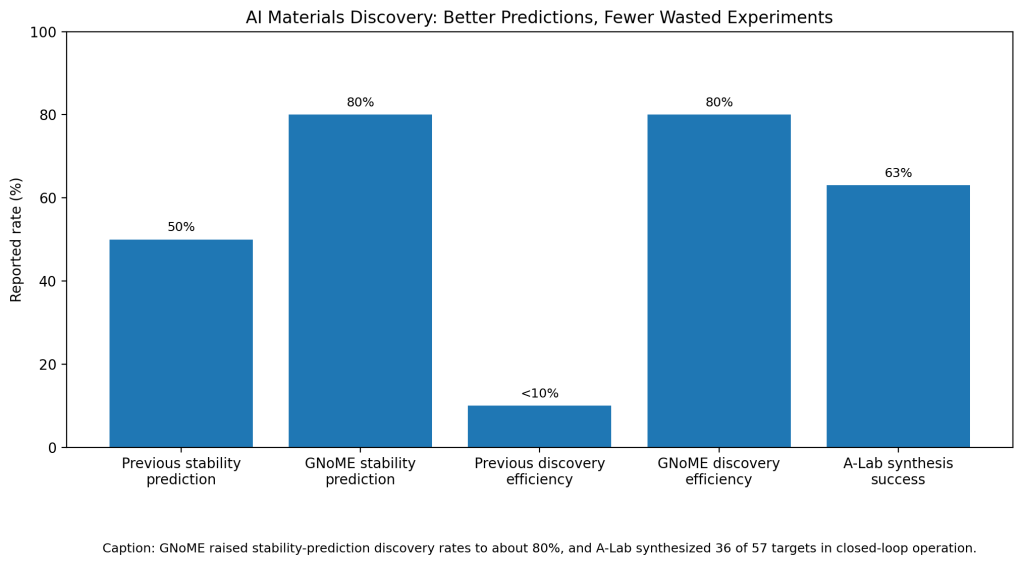
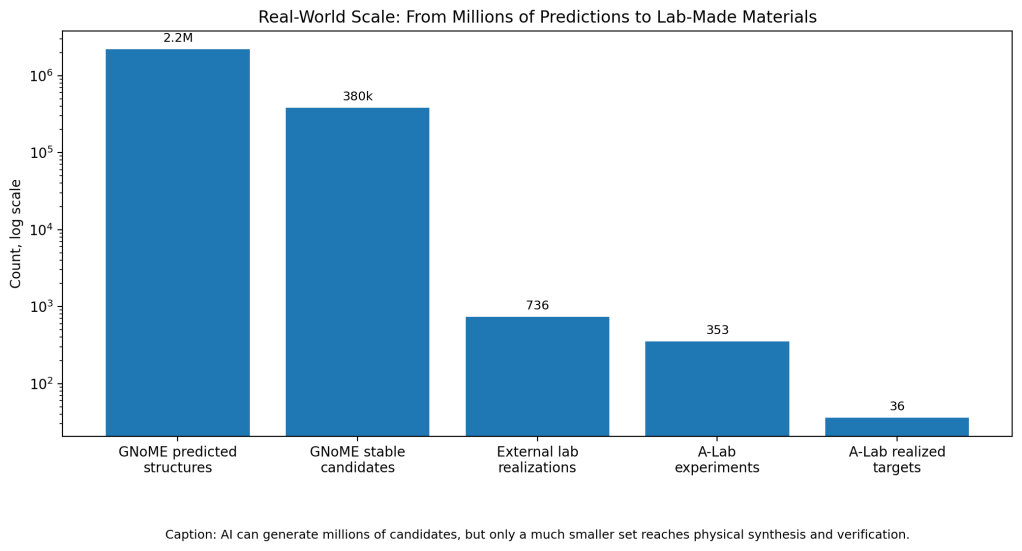
Google DeepMind’s GNoME showed the scale of the shift. The model predicted 2.2 million new crystal structures and identified 380,000 as stable candidates for experimental synthesis (Merchant and Cubuk). DeepMind said GNoME raised the discovery rate of materials stability prediction from around 50% to 80% on MatBench Discovery, and improved discovery efficiency from under 10% to over 80% (Merchant and Cubuk).
Berkeley Lab’s Materials Project also shows why this matters. The project is an open-access database that computes properties of known and predicted materials, letting researchers focus on promising structures instead of starting from scratch (Berkeley Lab). Google DeepMind added nearly 400,000 predicted stable compounds to that ecosystem (Berkeley Lab).
Recent reviews point in the same direction. Cao and colleagues’ 2026 systematic review says AI is now used for formability prediction, property discovery, experimental synthesis guidance, and validation across materials systems (Cao et al.).
Section 3: What the Real World Shows
The strongest real-world example is A-Lab at Lawrence Berkeley National Laboratory. A-Lab combines computations, literature data, machine learning, active learning, robotics, and X-ray diffraction analysis to plan and run solid-state synthesis experiments (Szymanski et al.). Over 17 days of closed-loop operation, A-Lab performed 353 experiments and realized 36 of 57 target inorganic crystalline solids, a 63% success rate (Szymanski et al.).
That is a different kind of evidence than a model leaderboard. The system did not only predict materials. It mixed powders, heated samples, analyzed results, and adjusted follow-up recipes. It also showed failure modes, because 17 targets were not obtained and some successful samples contained byproducts or low purity (Szymanski et al.).
GNoME also moved beyond theory. DeepMind reported that external researchers had independently created 736 of GNoME’s predicted new structures in concurrent work (Merchant and Cubuk). That does not mean all 2.2 million predictions are useful products. It does show that many AI-generated candidates can exist physically.
Section 4: The Implementation Gap
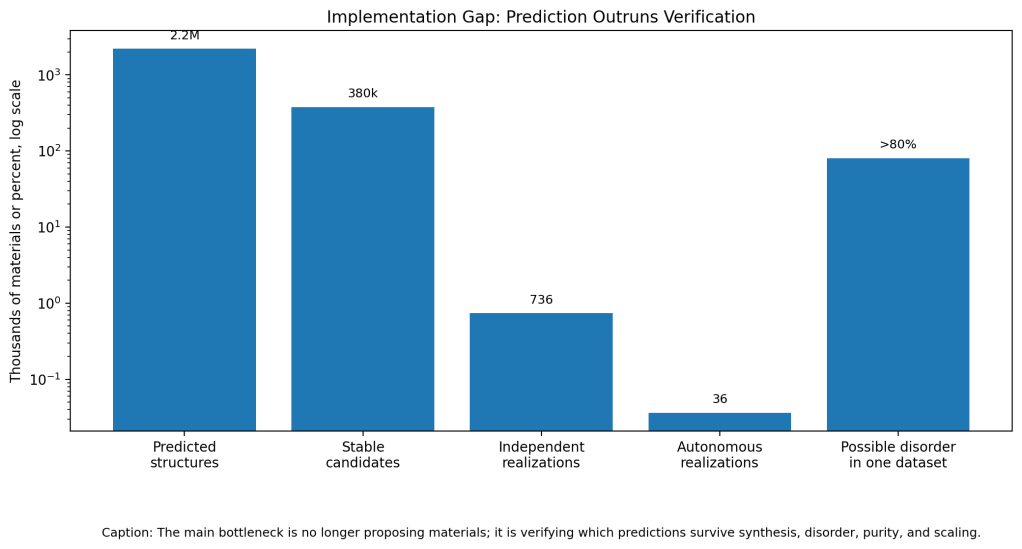
The biggest gap is that prediction outruns verification. GNoME produced 2.2 million predicted structures, but only 380,000 were selected as the most stable candidates, and far fewer have been synthesized and studied in detail (Merchant and Cubuk). The funnel gets narrow fast because a stable structure on a computer is not the same as a clean, scalable, useful material in a factory.
The second gap is synthesis. A-Lab’s 63% success rate is impressive, but it also means 37% of target materials were not realized in that run (Szymanski et al.). The paper notes that failed syntheses revealed problems in synthesis design and computational screening, which means lab feedback still matters (Szymanski et al.).
The third gap is disorder. A 2025 international study from the Fritz Haber Institute, Imperial College London, and the University of Bayreuth found that in one dataset, more than 80% of materials predicted by simulations showed signs of disorder, meaning their real behavior could differ from the clean computational structure (Fritz Haber Institute).
The fourth gap is data quality. Cao and colleagues argue that progress depends on better databases, machine learning, automated laboratories, and validation systems working together (Cao et al.). AI can propose candidates quickly, but it still needs clean training data, uncertainty estimates, experimental checks, and expert review.
Section 5: Where It Actually Works
This works best when prediction and experiment stay connected. GNoME created a large map of possible stable crystals. A-Lab tested selected targets, learned from failed recipes, and adjusted the next experiments. That closed loop is the real improvement, not the model alone.
It also works best for early-stage screening. Data science can narrow millions of structures into a smaller set worth testing. Robotic labs can then run repeatable experiments faster than a single human team. Human scientists still decide which properties matter, which failures are meaningful, and which materials deserve scale-up.
Section 6: The Opportunity
The opportunity is not instant invention. It is a shorter path from idea to proof. AI can propose materials, databases can rank them, robots can test them, and scientists can validate the results before companies waste years on weak candidates.
The next step is stronger evidence after synthesis: purity, stability under real conditions, manufacturability, cost, and performance in actual devices or products. Materials discovery will not become easy. It can become less blind.
References
[1] Liu, Yanjie, et al. “Materials Discovery and Design Using Machine Learning.” Journal of Materiomics, 2017.
[2] IBM Research. “Accelerating Discovery for Societal and Economic Impact.” 2022.
[3] Merchant, Amil, and Ekin Dogus Cubuk. “Millions of New Materials Discovered with Deep Learning.” Google DeepMind, 2023.
[4] Merchant, Amil, et al. “Scaling Deep Learning for Materials Discovery.” Nature, 2023.
[5] Lawrence Berkeley National Laboratory. “Google DeepMind Adds Nearly 400,000 New Compounds to Berkeley Lab’s Materials Project.” 2023.
[6] Szymanski, Nathan J., et al. “An Autonomous Laboratory for the Accelerated Synthesis of Inorganic Materials.” Nature, 2023.
[7] Cao, Ying, et al. “Artificial Intelligence Empowered New Materials: Discovery, Synthesis, Prediction to Validation.” Nano-Micro Letters, 2026.
[8] Otyepka, Michal, et al. “Advancing Materials Discovery Through Artificial Intelligence.” Materials Today Advances, 2025.
[9] Fritz Haber Institute of the Max Planck Society. “New International Study Uncovers Major Limitations in AI-Driven Materials Discovery.” 2025.
[10] Cheetham, Anthony K. “Artificial Intelligence Driving Materials Discovery?” Chemistry of Materials, 2024.


Leave a Reply