Section 1: The Problem
Hiring is slow, expensive, and full of noise. Human resources specialists recruit, screen, interview, and place workers, and the U.S. Bureau of Labor Statistics projects about 81,800 openings for these roles each year from 2024 to 2034 (BLS). Employers need people to sort huge applicant pools, but humans miss strong candidates, favor familiar backgrounds, and get tired after repetitive screening.
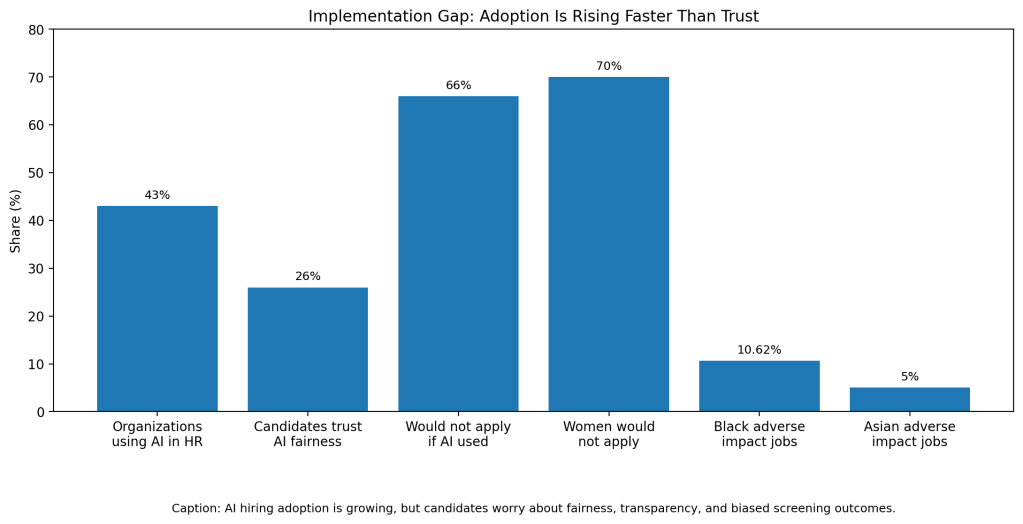
AI hiring tools promise a cleaner system. They parse resumes, rank candidates, run structured interviews, and identify applicants whose experience matches a role. SHRM reported that 43% of organizations used AI in HR tasks in 2025, up from 26% in 2024, which shows hiring AI has moved beyond small experiments (SHRM).
Traditional hiring falls short because resumes are weak signals. Referrals, school names, job titles, and formatting often influence attention before skill does. AI can help, but only when it improves evidence without hiding bias behind a score.
Section 2: What Research Shows
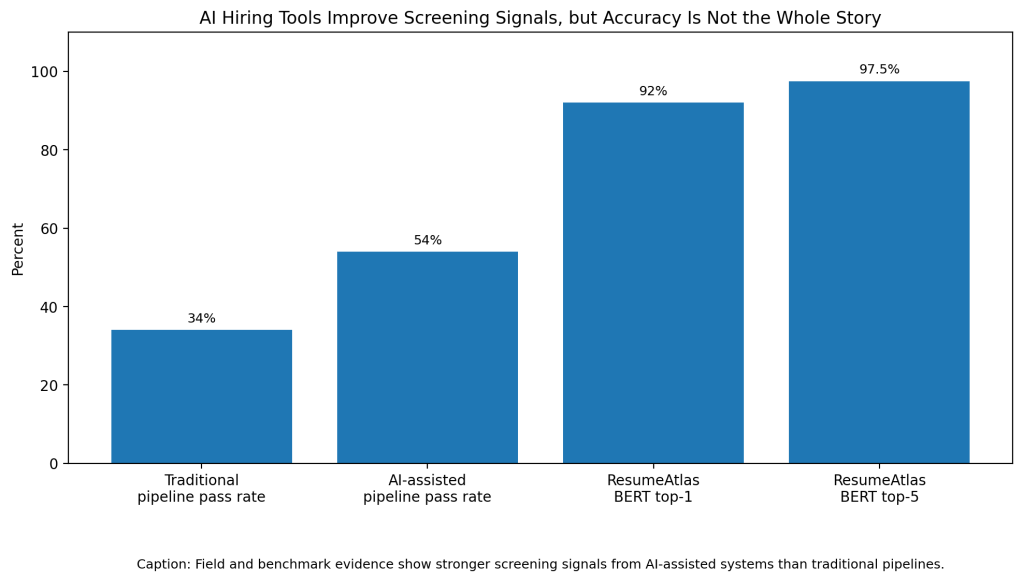
Resume classification models now perform well on large datasets. ResumeAtlas, a 2024 study using 13,389 resumes, reported that its best model reached 92% top-1 accuracy and 97.5% top-5 accuracy for resume classification (Heakl et al.).
Field evidence also supports AI-assisted screening. A 2025 field experiment for a junior software engineer role randomized about 37,000 LinkedIn applicants into a traditional pipeline or an AI-assisted pipeline. In the final human interview stage, 54% of candidates from the AI-assisted pipeline passed, compared with 34% from the traditional pipeline (Li et al.).
Systematic reviews show the same mixed pattern. Dadaboyev and colleagues reviewed 49 peer-reviewed articles from 2018 to 2025 and found AI can improve recruitment efficiency and candidate quality, but they also warned that algorithmic bias and ethical controls remain major problems (Dadaboyev et al.).
Section 3: What the Real World Shows
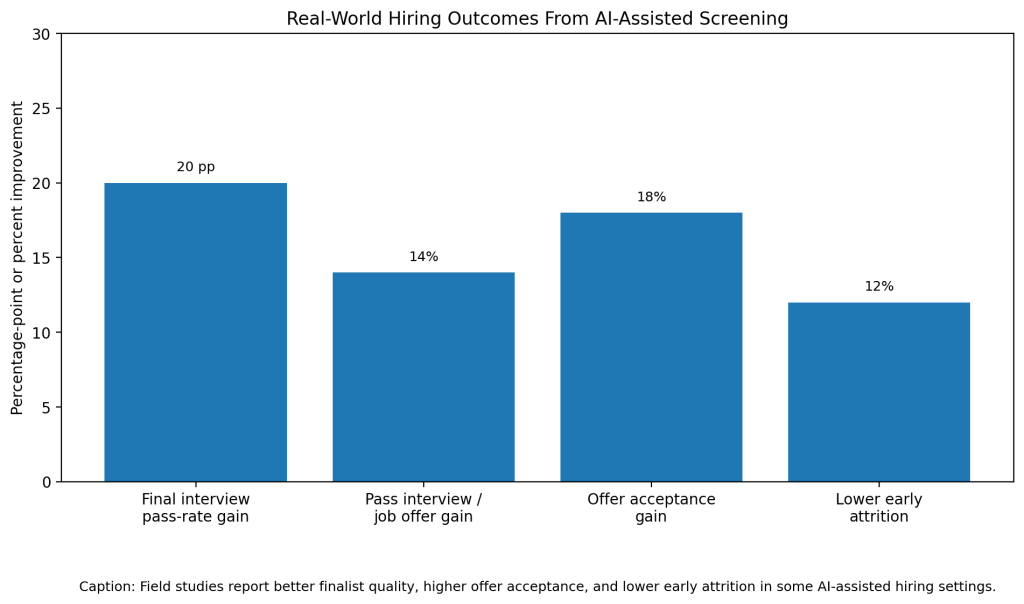
Cowgill tested machine-learning hiring in a field experiment for white-collar jobs. The system produced candidates who were 14% more likely to pass interviews and receive job offers, 18% more likely to accept offers, and 12% less likely to show early attrition (Cowgill).
Another 2025 field experiment by Dargnies, Hakimov, and Kübler tested algorithmic hiring against normal HR practice. The authors found algorithmic hiring was only marginally more efficient than managerial hiring, and its value depended on screening costs and worker performance gains (Dargnies et al.).
The lesson is simple. AI can find better signals than humans in some settings, but it does not automatically beat a human process. It works best when the hiring task has clear success measures, structured data, and a final human review.
Section 4: The Implementation Gap
The biggest gap is trust. Gartner reported in 2025 that only 26% of job candidates trust AI to evaluate them fairly, even though 52% believe AI screens their application information (Gartner). Pew found that 66% of U.S. adults would not want to apply for a job with an employer that uses AI to help make hiring decisions (Pew).
The second barrier is fairness. Rigotti and colleagues’ 2024 scoping review argues that AI recruitment tools carry high risks of privacy violations and social discrimination unless fairness is clearly defined and measured (Rigotti et al.).
The third barrier is real-world bias. A 2026 Stanford HAI report on hiring algorithms found significant adverse impact on Black and Asian applicants and warned that many employers using the same vendor can create “algorithmic monocultures,” where the same candidates get rejected across many employers (Stanford HAI).
The fourth barrier is candidate backlash. Pew found that 70% of women and 61% of men said they would not apply for a job where AI was used in hiring decisions (Pew). A tool that saves recruiter time can still hurt the employer if strong candidates refuse to enter the process.
Section 5: Where It Actually Works
AI hiring works best when it supports structured human decisions. In the 2025 junior software engineer field experiment, AI helped run a structured interview and recruiters reviewed AI-generated assessments before final interviews. Humans still made the final evaluation (Li et al.).
It also works better when employers test results after hiring. Cowgill measured interview success, offer acceptance, productivity, and attrition, not just resume-matching accuracy (Cowgill). That kind of validation matters because hiring quality shows up after the employee starts work.
Section 6: The Opportunity
The opportunity is not to let AI decide who gets a job. It is to make early screening more consistent, evidence-based, and auditable while keeping humans responsible for final decisions.
References
[1] U.S. Bureau of Labor Statistics. “Human Resources Specialists.” Occupational Outlook Handbook, 2025.
[2] SHRM. “The Role of AI in HR Continues to Expand.” 2025 Talent Trends, 2025.
[3] Heakl, Ahmed, et al. “ResumeAtlas: Revisiting Resume Classification with Large-Scale Datasets and Large Language Models.” arXiv, 2024.
[4] Li, et al. “AI-Assisted Recruitment and Selection Effectiveness: Evidence from a Field Experiment.” arXiv, 2025.
[5] Dadaboyev, S. M. U., et al. “Role of Artificial Intelligence in Employee Recruitment: Systematic Review and Future Research Directions.” Discover Global Society, 2025.
[6] Cowgill, Bo. “Bias and Productivity in Humans and Algorithms: Theory and Evidence from Résumé Screening.” 2020.
[7] Dargnies, Marie-Pierre, Rustamdjan Hakimov, and Dorothea Kübler. “Behavioral Measures Improve AI Hiring: A Field Experiment.” Discussion Paper, 2025.
[8] Gartner. “Gartner Survey Shows Just 26% of Job Applicants Trust AI Will Fairly Evaluate Them.” 2025.
[9] Pew Research Center. “Americans’ Views on Use of AI in Hiring.” 2023.
[10] Rigotti, Carlotta, et al. “Fairness, AI & Recruitment.” Computer Law & Security Review, 2024.


Leave a Reply