Section 1: The Problem
Wildlife is disappearing faster than conservation teams can measure it. The UN’s IPBES assessment found that around 1 million animal and plant species face extinction, many within decades (United Nations). WWF’s 2024 Living Planet Report found a 73% average decline in monitored wildlife populations from 1970 to 2020 (WWF).
Camera traps help because they photograph animals without people standing in the field. The issue is volume. A single survey can create thousands, hundreds of thousands, or even millions of images, and many of those images are empty because wind, grass, heat, or shadows trigger the camera (Ahumada et al.).
Traditional wildlife monitoring depends on humans sorting images by hand. That slows everything down. If managers do not know which species are present, where they move, or when they disappear from an area, they respond late.
Section 2: What Research Shows
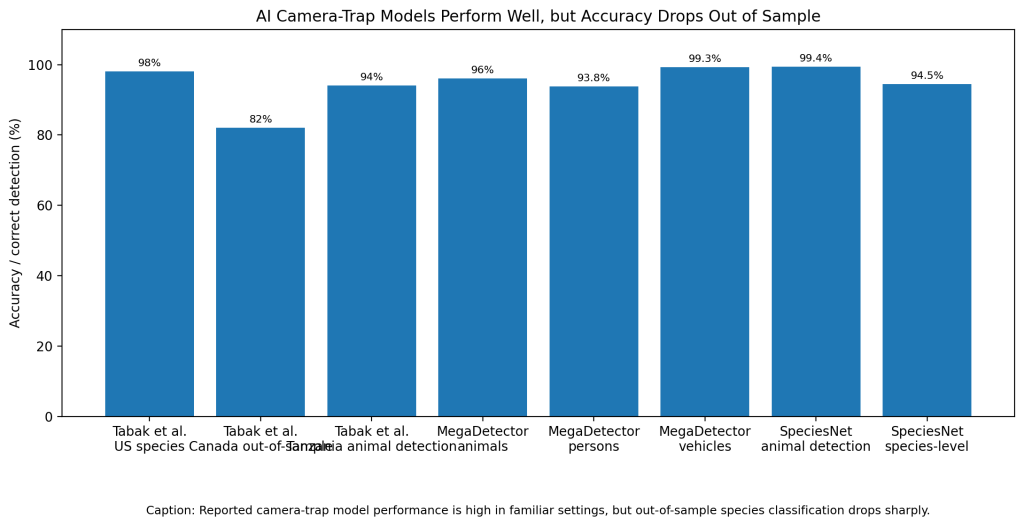
Machine learning works well on many camera-trap tasks. Tabak and colleagues trained a ResNet-18 model on 3,367,383 camera-trap images from five U.S. states. It reached 98% accuracy for U.S. species, 82% accuracy on an out-of-sample Canadian dataset, and correctly identified 94% of animal-containing images in a Tanzanian dataset with a new wildlife community (Tabak et al.).
MegaDetector also performs well for broad detection. Mitterwallner and colleagues tested more than 300,000 camera-trap images from three study regions and found 96.0% accuracy for animals, 93.8% for people, and 99.3% for vehicles at a 95% confidence threshold (Mitterwallner et al.).
The field keeps moving toward deep learning. A 2025 systematic review on camera-trap species identification found that deep neural networks have become central to automating wildlife identification from images (Mamapule et al.).
Section 3: What the Real World Shows
The clearest real-world test came from Washington State University and Google in 2026. The team compared SpeciesNet AI labels with expert human labels across camera-trap data from Washington, Glacier National Park, and Guatemala’s Maya Biosphere Reserve. For most species, AI and human workflows produced similar occupancy conclusions in roughly 85-90% of cases (Thornton et al.).
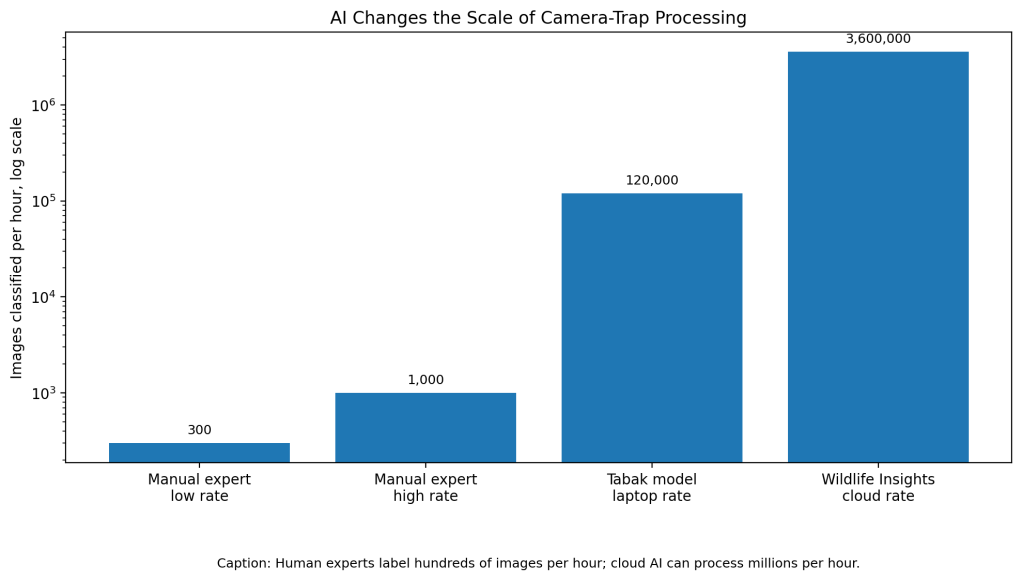
That matters because speed changes the decision cycle. The WSU report said AI can cut camera-trap analysis from months, or even a year, to days while producing similar ecological conclusions for many species (Thornton et al.).
Wildlife Insights shows what deployment looks like. Its SpeciesNet model has been trained on more than 65 million images. WWF reports that it detects 99.4% of images containing animals, is correct 98.7% of the time when it predicts an animal is present, and reaches 94.5% accuracy when it makes a species-level prediction (WWF).
Section 4: The Implementation Gap
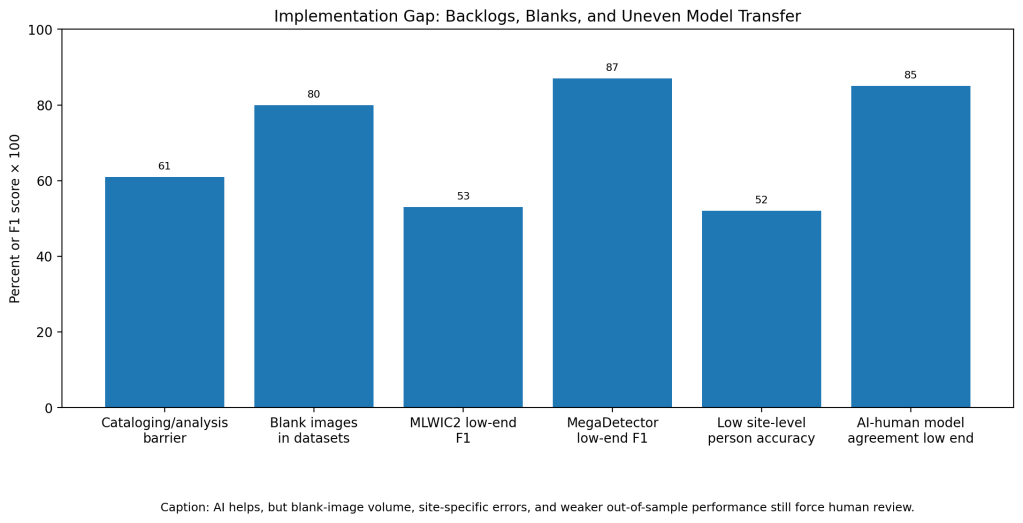
The first barrier is the backlog. Ahumada and colleagues found that 61% of surveyed camera trappers named image cataloguing and data analysis as major barriers. They also argued that the camera-trap data pipeline needs to become at least 10 times faster to support conservation decisions (Ahumada et al.).
The second barrier is false confidence. Models look strong in benchmark settings, then weaken when moved to new places. Tabak’s model reached 98% accuracy in the U.S. but dropped to 82% on an out-of-sample Canadian dataset (Tabak et al.).
The third barrier is species-level recall. Vélez and colleagues reviewed Conservation AI, MegaDetector, MLWIC2, and Wildlife Insights. They found that species classifications from Conservation AI, MLWIC2, and Wildlife Insights usually had low to moderate recall, so most users still need to review predictions before accepting final labels (Vélez et al.).
The fourth barrier is uneven field performance. Mitterwallner and colleagues found that person-detection accuracy at one site ranged as low as 52% at a 95% confidence threshold, and the model struggled with blurry images, moving vegetation, bikes, body parts, and close objects (Mitterwallner et al.).
Section 5: Where It Actually Works
AI works best when teams use it for triage before full automation. It can remove blank images, group likely species, and flag uncertain cases for review. That saves expert time without pretending the model is perfect.
SpeciesNet works well because it combines a large training base, a real platform, and conservation partners. In Peru’s Tahuamanu region, WWF used 136 camera traps and SpeciesNet processing to identify 37 individual jaguars and monitor other species, including tapirs, peccaries, and ocelots (WWF).
Section 6: The Opportunity
AI will not save wildlife by itself. It can give conservation teams faster, cleaner evidence so they can decide where to protect habitat, where populations are dropping, and where human activity is changing animal behavior.
References
[1] United Nations. “UN Report: Nature’s Dangerous Decline ‘Unprecedented.’” 2019.
[2] World Wildlife Fund. 2024 Living Planet Report. 2024.
[3] Ahumada, Jorge A., et al. “Wildlife Insights: A Platform to Maximize the Potential of Camera Trap and Other Passive Sensor Wildlife Data for the Planet.” Environmental Conservation, 2020.
[4] Tabak, Michael A., et al. “Machine Learning to Classify Animal Species in Camera Trap Images: Applications in Ecology.” Methods in Ecology and Evolution, 2019.
[5] Mitterwallner, Veronika, et al. “Automated Visitor and Wildlife Monitoring with Camera Traps and Machine Learning.” Remote Sensing in Ecology and Conservation, 2024.
[6] Mamapule, Siyabonga, Bukohwo Michael Esiefarienrhe, and Ibidun Christiana Obagbuwa. “Automatic Wildlife Species Identification on Camera Trap Images Using Deep Learning Approaches: A Systematic Review.” Indonesian Journal of Electrical Engineering and Computer Science, 2025.
[7] Thornton, Daniel, et al. “Identification of Camera Trap Images by Artificial Intelligence and Human Experts Produce Similar Multi-Species Occupancy Models.” Journal of Applied Ecology, 2026.
[8] Vélez, Juliana, et al. “An Evaluation of Platforms for Processing Camera-Trap Data Using Artificial Intelligence.” Methods in Ecology and Evolution, 2023.
[9] World Wildlife Fund. “Using the Power of AI to Identify and Track Species.” 2025.
[10] Birch, Tanya, and Jorge Ahumada. “Using AI to Find Where the Wild Things Are.” Google, 2019.
 Aethel.
Leave a comment