Section 1: The Problem
False information moves faster than correction. Vosoughi, Roy, and Aral studied about 126,000 stories tweeted by roughly 3 million people more than 4.5 million times and found false news spread farther, faster, deeper, and more broadly than true news (Vosoughi et al.).
The stakes are high because social platforms now act like news infrastructure. Pew reported in 2025 that 53% of U.S. adults at least sometimes get news from social media, while Facebook, YouTube, Instagram, TikTok, and X all serve as news sources for millions of users (Pew Research Center).
People know the information environment is shaky. The Reuters Institute’s 2024 Digital News Report found that 59% of respondents across markets were concerned about what is real or fake online, with concern reaching 72% in the United States (Newman et al.).
Traditional fact-checking helps, but it moves slowly. Human reviewers need time to identify a claim, check evidence, write a correction, and attach it to content. By then, the post may already have reached most of its audience.
Section 2: What Research Shows
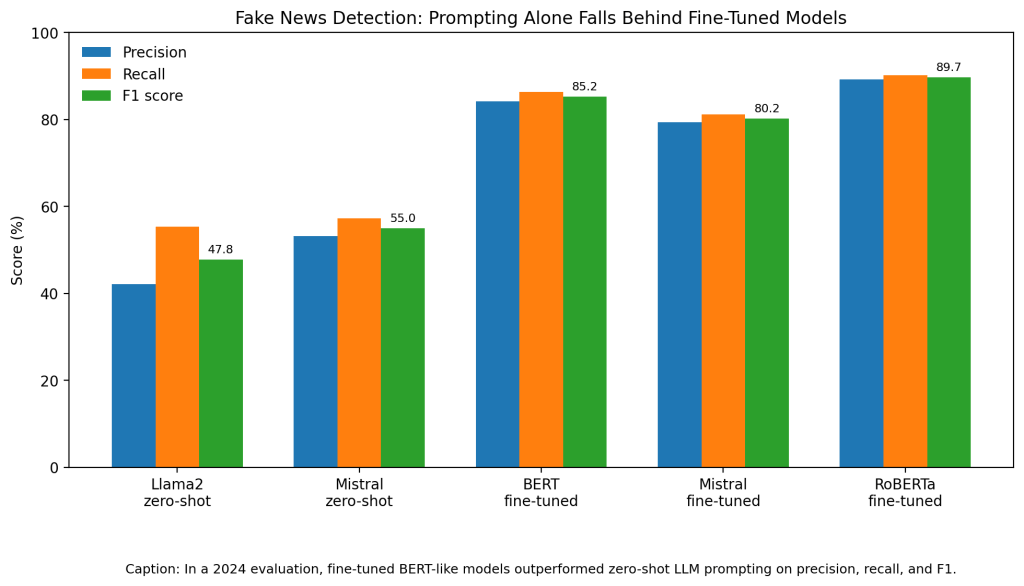
Machine learning gives platforms a faster first filter. Raza and colleagues tested fake-news classifiers on a dataset labeled with GPT-4 support and verified by human reviewers. RoBERTa reached 89.23% precision, 90.14% recall, and 89.68% F1, while zero-shot Llama2 reached only 42.15% precision, 55.37% recall, and 47.75% F1 (Raza et al.).
The same study found fine-tuning mattered more than using a large model with no task training. Fine-tuned Mistral reached 80.23% F1, while zero-shot Mistral reached 55.00% F1 (Raza et al.).
A 2025 systematic review by Nasser screened recent multimodal fake-news detection research from 2018 to 2025. The review started with about 963 quality articles and selected 121 studies, finding transformer and recurrent neural models among the most used deep learning approaches (Nasser).
Section 3: What the Real World Shows
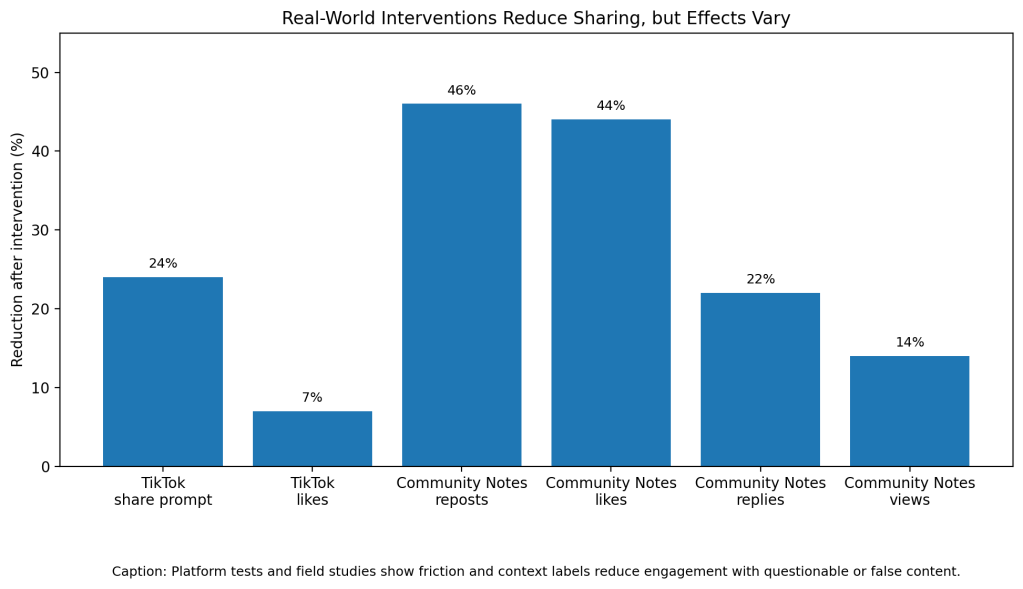
Real-world interventions work best when they add friction at the moment of sharing. TikTok tested a prompt for videos reviewed but not conclusively validated. Viewers shared flagged videos 24% less often, and likes dropped 7% (TikTok).
Community Notes shows a similar pattern at platform scale. A University of Washington-led study tracked 40,000 X posts with proposed notes from March to June 2023. Of those, 6,757 notes were attached, and after notes appeared, reposts dropped 46%, likes dropped 44%, replies dropped 22%, and views dropped 14% (Slaughter et al.).
Renault, Restrepo-Amariles, and Troussel-Clément built a database of about 285,000 Community Notes and found that adding context reduced retweets by 49.1% in one causal estimate. They also found Community Notes increased the chance a tweet was deleted by its creator by 80% (Renault et al.).
Section 4: The Implementation Gap
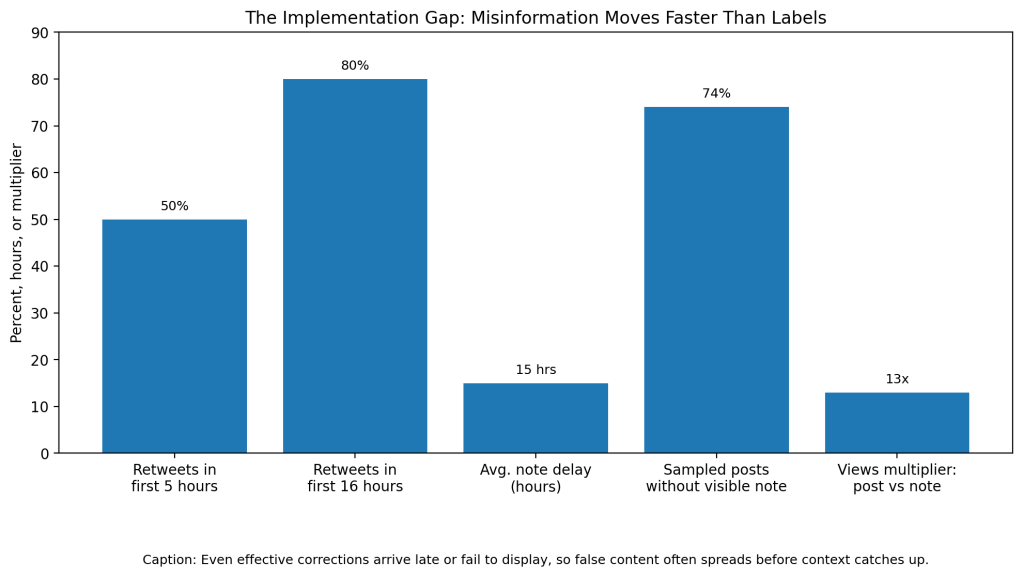
The first barrier is speed. Renault and colleagues found around 50% of retweets happen in the first 5 hours and 80% happen after 16 hours. The average Community Note appeared after about 15 hours, which means correction often arrives after most spread already happened (Renault et al.).
The second barrier is coverage. The Associated Press reported that the Center for Countering Digital Hate analyzed 283 misleading election posts and found accurate Community Notes were not displayed on 209 of them, or 74% (Ortutay).
The third barrier is trust. Drolsbach and colleagues note that social platforms use professional fact-checkers, but distrust limits impact. Their paper reports that 70% of Republican partisans and half of U.S. adults believe fact-checkers are biased (Drolsbach et al.).
The fourth barrier is model brittleness. Liu’s 2024 systematic review found common problems across fake-news and deceptive-content detection studies, including selection bias, class imbalance, inconsistent preprocessing, and overreliance on accuracy in imbalanced datasets (Liu et al.).
Section 5: Where It Actually Works
It works when platforms combine speed, context, and human review. TikTok’s prompt worked because it appeared at the exact sharing decision, not hours later (TikTok).
Community Notes works when notes attach quickly and reach users before diffusion peaks. Slaughter and colleagues found notes reduced reposts and likes most clearly after attachment, but late notes had weaker effects (Slaughter et al.).
Section 6: The Opportunity
The goal is not to let AI decide truth alone. The goal is to use AI to triage risky content fast, send the hardest cases to humans, and apply visible context before misinformation spreads.
References
[1] Vosoughi, Soroush, Deb Roy, and Sinan Aral. “The Spread of True and False News Online.” Science, 2018.
[2] Pew Research Center. “Social Media and News Fact Sheet.” 2025.
[3] Newman, Nic, et al. Digital News Report 2024. Reuters Institute for the Study of Journalism, 2024.
[4] Raza, Shaina, Drai Paulen-Patterson, and Chen Ding. “Fake News Detection: Comparative Evaluation of BERT-like Models and Large Language Models with Generative AI-Annotated Data.” arXiv, 2024.
[5] Nasser, M. “A Systematic Review of Multimodal Fake News Detection on Social Media Using Deep Learning Models.” Results in Engineering, 2025.
[6] TikTok Newsroom. “New Prompts to Help People Consider Before They Share.” 2021.
[7] Slaughter, Isaac, et al. “Community Notes Reduce Engagement With and Diffusion of Misinformation.” Proceedings of the National Academy of Sciences, 2025.
[8] Renault, Thomas, David Restrepo-Amariles, and Aurore Troussel-Clément. “Collaboratively Adding Context to Social Media Posts Reduces the Sharing of False News.” arXiv, 2024.
[9] Drolsbach, Chiara P., et al. “Community Notes Increase Trust in Fact-Checking on Social Media.” PNAS Nexus, 2024.
[10] Liu, Y., et al. “A Systematic Review of Machine Learning Approaches for Detecting Misinformation, Spam, and Fake Accounts on Social Media.” arXiv, 2024.


Leave a Reply