Section 1: The Problem
Customer service is one of the largest front doors into the economy. Customer service representatives held about 2.8 million U.S. jobs in 2024, and the Bureau of Labor Statistics projects about 341,700 openings each year even as employment declines 5% from 2024 to 2034 (Bureau of Labor Statistics).
The work is also stressful. Agents handle complaints, returns, billing issues, service problems, and frustrated customers across phone, chat, email, and social media (Bureau of Labor Statistics). When the queue grows, traditional support teams rely on manual triage, scripts, escalation rules, and supervisor review. Those systems break down when customers describe the same issue in hundreds of different ways.
Traditional support also wastes skilled human time. Simple tickets sit beside urgent tickets. New agents search through old cases. Customers repeat the same problem across channels. AI promises a better system: classify the issue, rank likely answers, suggest a response, and route complex cases to a human.
Section 2: What Research Shows
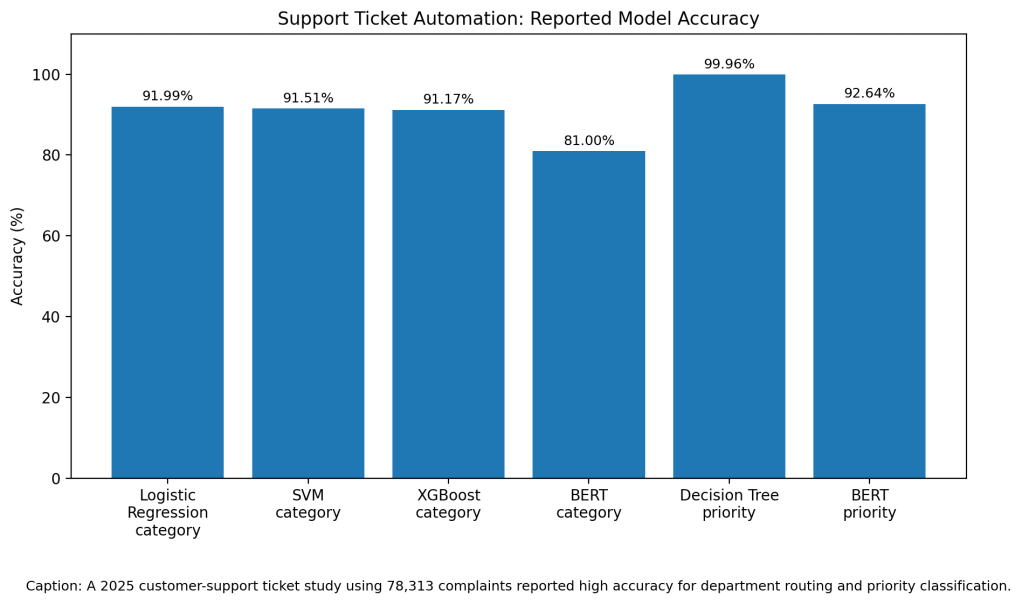
Support-ticket automation has strong retrospective results. A 2025 NLP ticket study used 78,313 customer complaints and tested models for department categorization and priority classification. Logistic regression reached 91.99% accuracy for department classification, followed by SVM at 91.51% and XGBoost at 91.17%. For priority classification, decision tree reached 99.96% accuracy, while BERT reached 92.64% (Selvi et al.).
Other research shows better model design matters. Zangari and colleagues studied ticket automation in multi-level classification settings and found ML-BERT outperformed the best baseline by up to 5.7 percentage points in F1 score and 5.4 percentage points in accuracy on a bugs dataset (Zangari et al.).
A 2025 systematic review of 39 generative AI chatbot studies from 2020 to 2025 found broad deployment across domains, including customer service and industry. It also found gaps in standardization, evaluation methods, domain-specific reliability, explainability, scalability, and external validation (Aldhafeeri et al.).
Section 3: What the Real World Shows
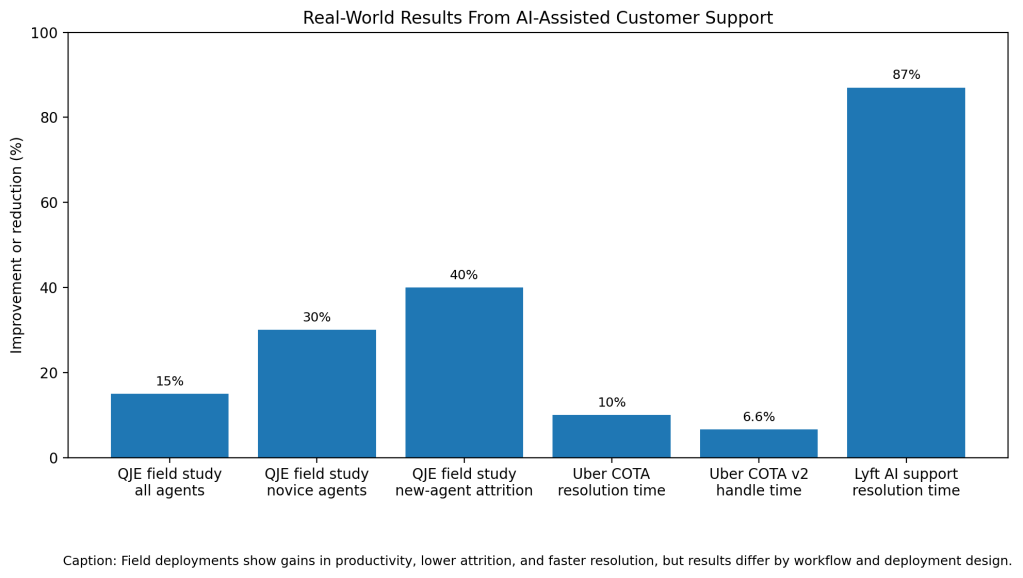
The best field evidence comes from a large workplace study published in The Quarterly Journal of Economics. Brynjolfsson, Li, and Raymond studied a generative AI assistant used by 5,172 customer-support agents. Access to AI assistance increased productivity by 15%, measured by customer issues resolved per hour (Brynjolfsson et al.).
The same study found the gains were largest for less experienced and lower-skill agents. Newer agents improved fastest, and agents with two months of tenure plus AI performed about as well as agents with more than six months of tenure without AI (Brynjolfsson et al.). New-agent attrition fell by about 10 percentage points, a 40% drop from a 25% baseline (Brynjolfsson et al.).
Uber’s COTA system gives another field example. The company reported that its machine-learning ticket assistant reduced ticket resolution time by more than 10% while keeping customer satisfaction similar or higher (Uber). A later deep learning version reduced average handle time by 6.6% in A/B testing and improved recommendation accuracy (Uber).
Section 4: The Implementation Gap
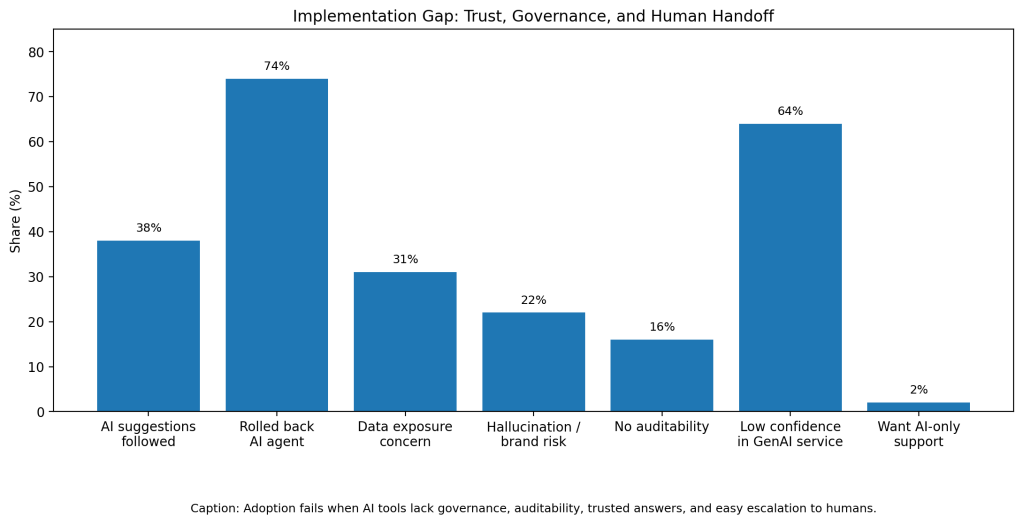
The first barrier is trust. A 2026 Pegasystems and YouGov survey found 64% of consumers lacked confidence in how businesses use generative AI in customer interactions, and 53% lacked confidence that organizations use it responsibly (Pega). Only 2% wanted chatbot-only support, while 77% said human-only service often or always produced better outcomes (Customer Experience Dive).
The second barrier is governance. A 2026 Sinch survey reported by ITPro found 74% of companies had rolled back or shut down at least one AI customer-communications agent due to governance failures. The leading causes were customer data exposure at 31%, hallucinations or brand risk at 22%, and lack of auditability at 16% (Kobie).
The third barrier is weak human adoption. In the QJE field study, agents followed AI recommendations only 38% of the time on average, with an interquartile range of 23% to 50% (Brynjolfsson et al.). This matters because AI support tools only work when agents trust them enough to use them, but still edit them when needed.
The fourth barrier is the handoff problem. AI-only support frustrates customers when it blocks escalation. Lyft said safety, deactivation, fraud, and complex cases still require human agents, even after its AI system reduced average customer-service resolution time by 87% and handled thousands of requests each day (Sriram).
Section 5: Where It Actually Works
AI support works best as agent assistance, not as a wall between the customer and a person. The QJE study’s tool watched conversations and suggested replies, but agents stayed responsible for the conversation and were free to ignore or edit the suggestions (Brynjolfsson et al.).
It also works when companies measure real outcomes, not model demos. Uber tested COTA inside production workflows and tracked resolution time and customer satisfaction. Lyft kept humans for complex cases. Those designs treat AI as a routing and response layer, not a full replacement for judgment.
Section 6: The Opportunity
The opportunity is not chatbot-only service. It is faster human service with AI doing the sorting, summarizing, ranking, and first-draft response work.
References
[1] Bureau of Labor Statistics. “Customer Service Representatives.” Occupational Outlook Handbook, 2025.
[2] Selvi, C. S. Kanimozhi, et al. “Customer Support Ticket Categorization and Prioritization Using Natural Language Processing.” INCOFT, 2025.
[3] Zangari, Alessandro, et al. “Ticket Automation: An Insight into Current Research with Applications to Multi-Level Classification Scenarios.” Expert Systems with Applications, 2023.
[4] Aldhafeeri, Latifah, et al. “Generative AI Chatbots Across Domains: A Systematic Review.” Applied Sciences, 2025.
[5] Brynjolfsson, Erik, Danielle Li, and Lindsey R. Raymond. “Generative AI at Work.” The Quarterly Journal of Economics, vol. 140, no. 2, 2025, pp. 889-942.
[6] Molino, Piero, Huaixiu Zheng, and Yi-Chia Wang. “COTA: Improving the Speed and Accuracy of Customer Support through Ranking and Deep Networks.” KDD, 2018.
[7] Uber Engineering. “COTA: Improving Uber Customer Care with NLP & Machine Learning.” Uber Blog, 2018.
[8] Uber Engineering. “Scaling Uber’s Customer Support Ticket Assistant System with Deep Learning.” Uber Blog, 2018.
[9] Sriram, Akash. “Lyft Ties Up with Anthropic for AI-Powered Customer Care.” Reuters, 2025.
[10] Kobie, Nicole. “AI Agents Aren’t Cutting It in Customer Service.” ITPro, 2026.


Leave a comment