Section 1: The Problem
Invasive species are not a niche ecology issue. They now cost the world more than $423 billion each year, and those costs have been rising roughly fourfold per decade since the 1970s. Early detection matters because prevention and rapid response are usually far cheaper than cleanup after a species spreads. (El Jamaai et al.; Bradshaw et al.)
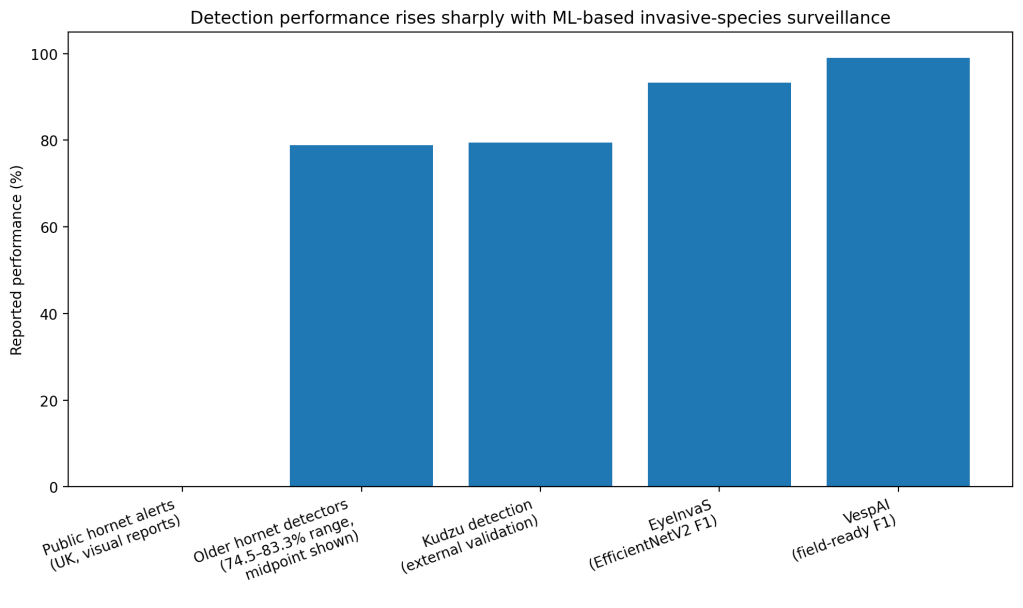
The weak point is surveillance. Agencies still rely heavily on manual surveys, public reports, and scattered monitoring programs. Those methods miss rare early incursions, especially when the target species is small, mobile, or easy to confuse with native species. In the UK, public visual alerts for the invasive Asian hornet had a mean accuracy of only 0.06%, which is almost useless for fast exclusion work. (O’Shea-Wheller et al.)
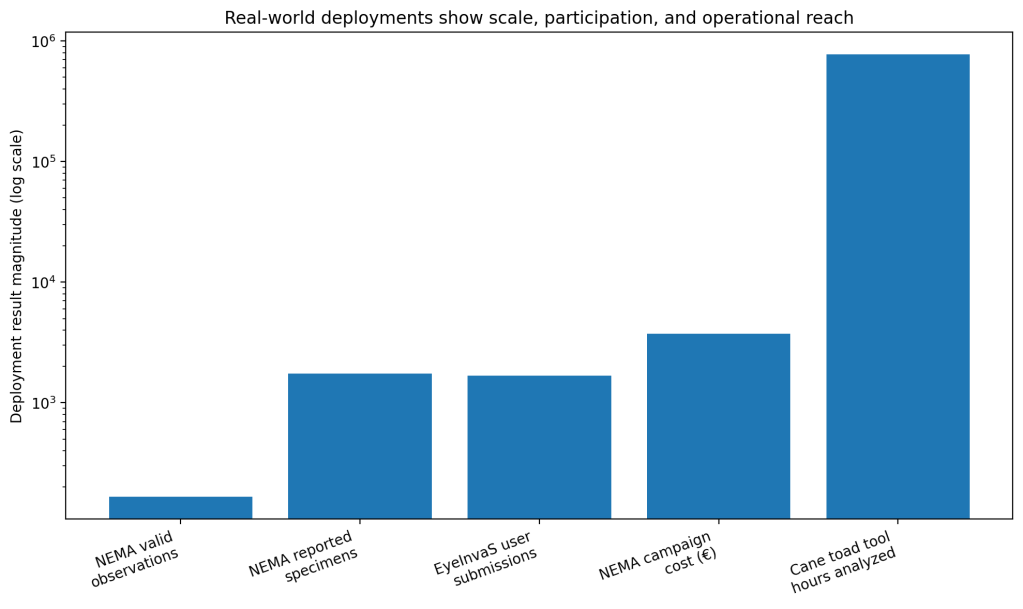
Traditional fieldwork also burns money fast. In Portugal, a low-cost marine invasive-species campaign showed that collecting equivalent field information with one scientist would have cost more than €11,000, while the campaign itself would have cost about €3,751 in staff time. That gap explains why many agencies monitor too little territory, too infrequently, and too late. (Encarnação et al.)
Section 2: What Research Shows
The retrospective evidence is strong. In a 2020 study on kudzu detection in the southeastern United States, Jensen and colleagues tested five machine-learning classifiers and found internal accuracies around 97%. Even after moving to a broader external validation area, accuracy held at 79.5%, which is far better than unaided visual searching over large landscapes. (Jensen et al.)
The newer invasive-hornet work is even stronger. VespAI, published in 2024, used a YOLOv5s system with a ResNet backbone and reached a precision-recall score of at least 0.99. The paper also notes that earlier operational hornet-detection systems typically sat in the 74.5% to 83.3% accuracy range and often produced false detections from other insects. That gap matters because early-incursion monitoring fails when false positives swamp staff time. (O’Shea-Wheller et al.)
The pattern holds across broader reviews. A 2024 review of remote sensing and ML for invasive plants found that RF, SVM, ANN, CNN, and related methods consistently improve detection and mapping, especially when paired with hyperspectral, LiDAR, or UAV imagery. The same review also makes clear that better algorithms alone are not enough. Performance rises fastest when model design matches the biology of the species and the sensing environment. (Zaka and Samat)
Section 3: What the Real World Shows
The most useful studies are not lab demos. They are live systems. VespAI is one of them. The team trained on 3,302 images from Jersey, Portugal, France, and the UK, then showed successful prototype operation in the field. That matters because the paper is not only about model accuracy. It shows a deployable early-warning station built for actual exclusion work. (O’Shea-Wheller et al.)
A second example is EyeInvaS in China. Chen and colleagues built a public-facing deep-learning system covering 54 invasive alien species. EfficientNetV2 reached an F1 score of 83.66% on the original dataset and 93.32% on the hybrid dataset. In large-scale public deployment in Huai’an, the system received 1,683 user submissions and mapped the spread of Solidago canadensis, showing how informatics can turn ordinary citizens into early-warning sensors. (Chen et al.)
A third example came from Australia in 2025. Leung and colleagues used passive acoustic monitoring plus BirdNET to detect invasive cane toads across a continental-scale dataset. The system analyzed 778,039 hours of recordings and achieved over 90% accuracy even at many sites outside the training regions. That is a real operational result, not a toy benchmark. (Leung et al.)
Section 4: The Implementation Gap
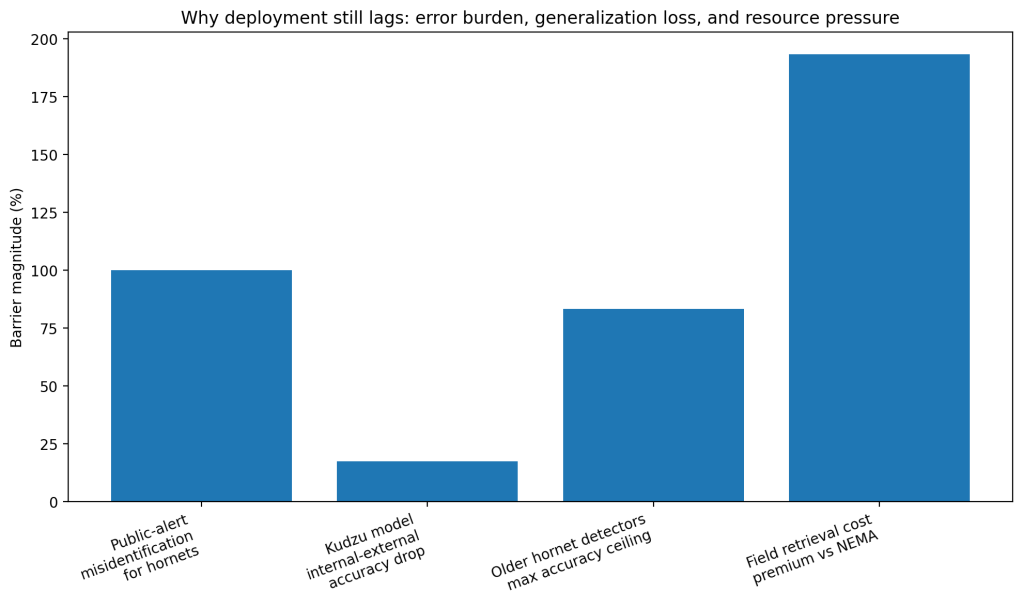
The first barrier is false alarms. Rare-event monitoring punishes even good models. VespAI’s authors explicitly argued that precision near 0.99 is necessary because a small false-positive rate becomes unmanageable when true positives are rare. Earlier hornet systems already showed the problem, with accuracy stuck around 74.5% to 83.3% and repeated confusion with non-target insects. (O’Shea-Wheller et al.)
The second barrier is generalization. Jensen’s kudzu system posted about 97% internal accuracy but dropped to 79.5% in external validation. That 17.5-point drop is exactly the kind of gap that makes managers hesitate. A model that looks excellent in one region or season can weaken once the background vegetation, sensor conditions, or species appearance shifts. (Jensen et al.)
The third barrier is infrastructure cost. The same invasive-plant review that celebrates hyperspectral and UAV methods also notes their cost and operational complexity. Jensen’s paper says airborne hyperspectral data is powerful but expensive, which makes scaling harder for routine surveillance. Many agencies do not lack interest. They lack budget, staff, and repeatable data pipelines. (Jensen et al.; Zaka and Samat)
The fourth barrier is human capacity. A 2025 review on AI in ecology argued that practical barriers often block adoption more than ethical concerns do, and flagged the need for human review, interpretable methods, and stronger technical literacy. Another 2025 ecology review warned that technical and environmental barriers limit ML access for ecologists and decision-makers, especially in under-resourced regions. That is why many papers stop at proof of concept. (Kendall-Bar et al.; Cipriano et al.)
Section 5: Where It Actually Works
These tools work best when they do one job well. VespAI watches a standardized bait station. EyeInvaS turns phone photos into geotagged reports. The cane-toad system listens for one recognizable signal across huge acoustic archives. Each system narrows the task, controls the input, and keeps the output usable by real managers. (O’Shea-Wheller et al.; Chen et al.; Leung et al.)
They also work when humans stay in the loop. The best systems do not replace ecologists. They shrink the search area, rank alerts, and increase coverage. That makes response teams faster without forcing them to trust a black box on its own. (Chen et al.; Kendall-Bar et al.)
Section 6: The Opportunity
Early invasive-species detection is one of the clearest places where data science already beats traditional practice. The real opportunity is not one more benchmark paper. It is building cheap, local, interpretable monitoring systems that agencies and citizen networks will use every week, not once per pilot. (El Jamaai et al.; Zaka and Samat)
Takeaways
- Standardize data collection first, then train models on that workflow.
- Use AI to rank alerts, not to make final eradication decisions alone.
- Measure external validation loss, not only in-sample accuracy.
- Design for low-cost sensors, phones, and public reporting from the start.
- Budget for retraining, not only for first deployment.
Charts
References
[1] El Jamaai, Jamal, et al. “Biological Invasions and Their Potential Economic Costs in Morocco.” Scientific Reports, 2026.
[2] Bradshaw, Corey J. A., et al. “Damage Costs from Invasive Species Exceed Management Expenditure in Nations Experiencing Lower Economic Activity.” Ecological Economics, vol. 220, 2024, article 108166.
[3] O’Shea-Wheller, Thomas A., et al. “VespAI: A Deep Learning-Based System for the Detection of Invasive Hornets.” Communications Biology, vol. 7, 2024, article 354.
[4] Jensen, Tobias, et al. “Employing Machine Learning for Detection of Invasive Species Using Sentinel-2 and AVIRIS Data: The Case of Kudzu in the United States.” Sustainability, vol. 12, no. 9, 2020, article 3544.
[5] Zaka, Muhammad Murtaza, and Alim Samat. “Advances in Remote Sensing and Machine Learning Methods for Invasive Plants Study: A Comprehensive Review.” Remote Sensing, vol. 16, no. 20, 2024, article 3781.
[6] Chen, H., et al. “EyeInvaS: Lowering Barriers to Public Participation in Invasive Alien Species Monitoring Through Deep Learning.” Animals, vol. 15, no. 21, 2025, article 3181.
[7] Leung, Franco Ka Wah, et al. “Advancing Invasive Species Monitoring: A Free Tool for Detecting Invasive Cane Toads Using Continental-Scale Data.” Ecological Informatics, vol. 89, 2025, article 103172.
[8] Encarnação, João, et al. “Low-Cost Citizen Science Effectively Monitors the Rapid Expansion of a Marine Invasive Species.” Frontiers in Environmental Science, vol. 9, 2021, article 752705.
[9] Kendall-Bar, J. M., et al. “Challenges and Solutions for Ecologists Adopting AI.” 2025 review article.
[10] Cipriano, C., et al. “Algorithms Going Wild: A Review of Machine Learning Techniques for Terrestrial Ecology.” Ecological Modelling, 2025.
 Aethel.
Leave a comment