Section 1: The Problem
In 2022, U.S. fire departments responded to about 1.5 million fires, with about 3,790 civilian deaths, about 13,250 injuries, and about $18 billion in property damage. (Hall)
Residential fires dominate the human toll. In 2023, the U.S. saw an estimated 344,600 residential building fires, 2,890 deaths, 10,400 injuries, and about $11.27 billion in losses. (USFA) Home structure fires also keep repeating in predictable ways, tied to housing type, ignition source, and neighborhood risk patterns. (Ahrens, Home Structure Fires)
Traditional prevention still leans on broad messaging and schedule-driven inspection. Fire crews push “Fire Prevention Week” talks, hand out flyers, and run inspections based on code cycles or local habit. (McDonald) Those tools miss the core constraint: time. Most departments run short-staffed for prevention work, so they need sharp targeting, not more posters. (McDonald)
Section 2: What Research Shows
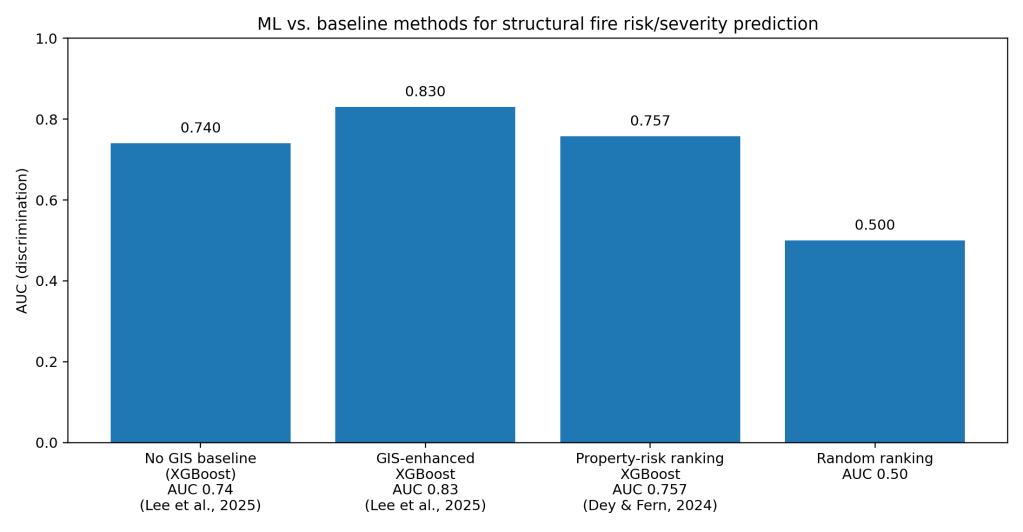
When departments score risk with data, model separation improves fast. A 2025 study on urban structural fires used XGBoost plus GIS features to predict early escalation risk, reaching AUC 0.83, versus 0.74 without GIS features. (Lee)
Property-level risk ranking works too. A 2024 AAAI paper trained models on a city dataset with over 72,000 properties to rank which addresses face higher fire likelihood. Its test AUC reached 0.757 for the main XGBoost ranking model, with 320 fire incidents in the test split. (Dey and Fern)
Those gains matter because prevention is a sorting problem. You do not need perfect prediction for every home. You need a ranked list that finds more true risk inside the first 50, 100, or 500 doors your team reaches this month. In the same 2024 work, the top-100 ranked properties included 16 properties with fire incidents, versus 1 in a random ranking. (Dey and Fern)
Section 3: What the Real World Shows
A rare field trial shows targeted home visits change outcomes. In Surrey, British Columbia, firefighters launched door-to-door prevention education plus smoke alarm check or installation in 2008. They completed 18,473 home visits across seven cohorts, about 13.8% of non-apartment dwellings in the city. (Clare)
The trial design used randomized high-risk cluster controls, so the comparison did not depend on anecdotes. The intervention cohorts saw a larger reduction in fire frequency than controls, and the fires that still happened showed better outcomes, with smoke alarms activating more often and fires staying confined to the object of origin more often after visits. (Clare)
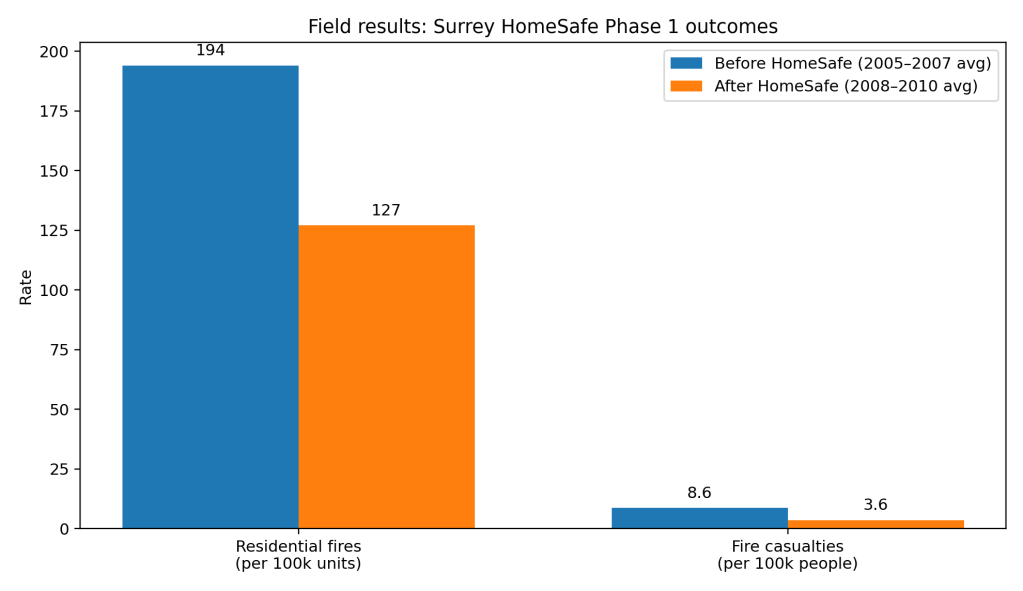
Surrey then scaled the approach into its HomeSafe program and tracked citywide outcomes. Phase 1 reported a drop in residential fire rate from 194 to 127 per 100,000 housing units, and a drop in casualty rate from 8.6 to 3.6 per 100,000 population, comparing 2005–2007 averages to 2008–2010 averages. (Garis and Al-Hajj, HomeSafe Phase 1)
A 2023 longitudinal assessment of Surrey’s HomeSafe program reviews the multi-year rollout and links program initiatives to fire-related outcome measures across time, reinforcing a consistent pattern: targeted, data-driven prevention aligns with measurable reductions in fires and casualties. (Al-Hajj)
System-level reviews also highlight the economic stakes. A 2023 systematic review of residential fire-related deaths and economic burden reports substantial direct and indirect costs across countries, tied to medical care, property loss, and productivity impacts. (Rahman)
Section 4: The Implementation Gap
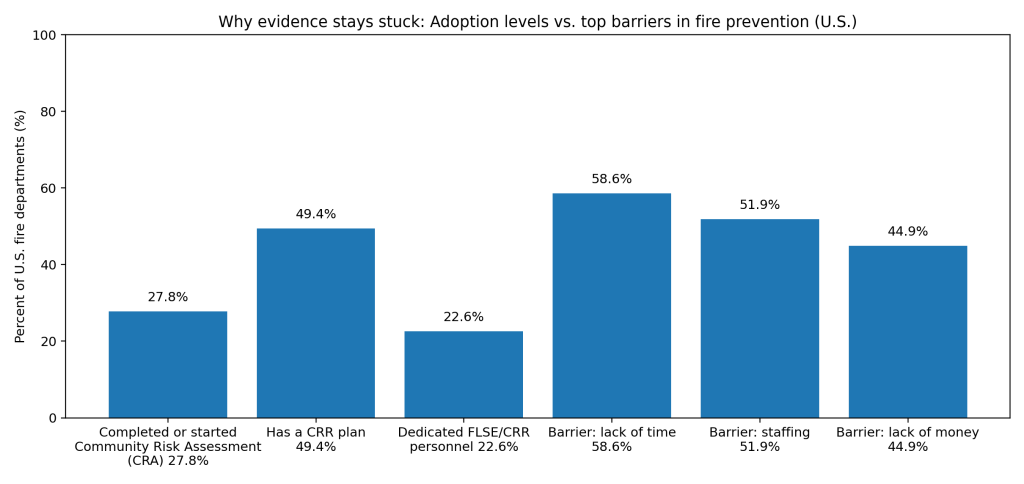
The evidence says “target the riskiest homes,” yet most departments do not run the basic planning steps needed for targeting. A 2023 Johns Hopkins national survey report found only 27.8% of U.S. fire departments had completed or started a Community Risk Assessment at the time of the survey. (McDonald)
Planning gaps continue after assessment. More than half, 50.6%, reported no Community Risk Reduction plan. Only 22.6% had personnel assigned exclusively to FLSE or CRR. (McDonald)
Departments also do not measure prevention results, which blocks learning loops. The same survey estimated 62.7% did not evaluate prevention activities, leaving departments unable to prove impact, refine targeting, or defend budget requests. (McDonald)
Three barriers dominate, and they are not abstract. Lack of time (58.6%), staffing challenges (51.9%), and lack of money (44.9%) lead the list. (McDonald) That barrier mix creates a trap: teams lack staff, so they avoid new workflows, then they lack outcome data, so they fail to win staff.
Risk tools also collide with trust and accountability. If a model flags a block as “high risk,” someone must explain why those homes get a knock while others do not. That requires interpretable features, careful messaging, and a process that aligns with local equity goals, not only AUC scores. (McDonald)
Another barrier sits inside the data itself. Property records contain missing fields, outdated occupancy info, and inconsistent address formats. The 2024 property-risk study shows how missingness patterns shape model behavior and performance, which translates into extra data-cleaning labor before any operational launch. (Dey and Fern)
Section 5: Where It Actually Works
Surrey worked because it paired data targeting with a delivery engine. Firefighters performed visits while on duty, so the program did not rely on a separate volunteer corps or a one-off grant cycle. (Clare) The program also bundled education with smoke alarm check and installation, linking insight to an immediate safety action. (Clare)
The same city also measured outcomes over time and kept adjusting, which supported scale beyond a single pilot neighborhood. That measurement discipline shows up in the reported pre/post rates and in the later longitudinal assessment. (Garis and Al-Hajj, HomeSafe Phase 1) (Al-Hajj)
Section 6: The Opportunity
Home fires still kill at scale, and smoke alarms still fail at scale. NFPA reports nearly 59% of home fire deaths occur in homes with no smoke alarms (43%) or alarms present but not operating (16%). (Ahrens, Smoke Alarms) That gap points to a practical target: identify homes least likely to have working alarms, then send the right intervention first.
Takeaways to improve adoption
- Fund one prevention analyst per region and share services across small departments, so CRA and CRR planning stops being “extra duty.” (McDonald)
- Treat model output as a ranked workload list tied to a monthly visit quota, not a binary “safe vs unsafe” label. (Dey and Fern)
- Build explainable risk factors into dashboards, so crews and residents see the why behind the knock. (Dey and Fern)
- Require outcome tracking as part of grants, with simple measures like working-alarm presence, repeat-incident rate, and injury counts. (McDonald)
- Pair targeting with a standard intervention bundle, education plus alarm check or install, because lives change only after action. (Clare) (Ahrens, Smoke Alarms)
References
[1] Hall, Shelby. “Fire Loss in the United States During 2022.” National Fire Protection Association (NFPA) Research, Nov. 2023. PDF.
[2] U.S. Fire Administration (USFA). “Residential Fire Estimate Summaries (2014–2023).” FEMA/USFA Statistics, 2023 national estimates. Web.
[3] Ahrens, Marty. “Home Structure Fires.” National Fire Protection Association (NFPA) Research, updated 2025. PDF.
[4] Ahrens, Marty. “Smoke Alarms in US Home Fires.” National Fire Protection Association (NFPA) Research, May 31, 2024. Web.
[5] Lee, et al. “Machine learning-based forecasting of urban fire impact in city environments.” PLOS ONE, 2025. Full text via PubMed Central (PMC).
[6] Dey, Rupasree, and Alan Fern. “Data-Driven Structural Fire Risk Prediction for City Properties.” Proceedings of the AAAI Conference on Artificial Intelligence, vol. 38, no. 21, 2024, pp. 22885–22891. DOI: 10.1609/aaai.v38i21.30325.
[7] Clare, Joseph, et al. “Reduced frequency and severity of residential fires following delivery of fire prevention education by on-duty fire fighters: Cluster randomized controlled study.” Journal of Safety Research, vol. 43, no. 2, 2012, pp. 123–128. DOI: 10.1016/j.jsr.2012.03.003.
[8] Garis, Len, and Sadeq Al-Hajj. “HomeSafe Phase 1, Outcomes Summary.” City of Surrey / Surrey Fire Service report on HomeSafe, 2010 outcomes window. PDF.
[9] Al-Hajj, Sadeq, et al. “Community Fire Risk Reduction: Longitudinal Assessment of the HomeSafe Program.” International Journal of Environmental Research and Public Health, vol. 20, no. 14, 2023, article 6369.
[10] McDonald, E. M., et al. “Prevention Activities in U.S. Fire Departments: Results and Recommendations from a National Survey.” Johns Hopkins Center for Injury Research and Policy, Mar. 2023. PDF.
 Aethel.
Leave a comment