Section 1:
Foodborne illness remains a large public health burden. Each year in the United States, 48 million people get sick, 128,000 are hospitalized, and 3,000 die from foodborne diseases (CDC). That scale places enormous pressure on local health departments to detect unsafe restaurants before outbreaks spread.
Cities often manage tens of thousands of food establishments with limited inspection staff. Chicago oversees more than 15,000 restaurants and food businesses, yet inspector staffing creates hundreds of establishments per inspector (City of Chicago). Routine inspection cycles mean many risky locations are visited on fixed schedules rather than based on real-time risk.
Traditional inspection systems rely on past violations, complaint calls, and fixed risk categories. These methods often detect problems only after customers report illness or after conditions worsen. Critical violations, especially temperature control failures, directly raise pathogen growth risk and trigger failed inspections, yet they may remain undetected for weeks under routine scheduling (City of Chicago).
Section 2: What Research Shows
Retrospective machine learning studies show stronger targeting performance than routine scheduling. In England and Wales, Oldroyd, Morris, and Birkin trained models on 92,595 food outlets to predict broad non-compliance. Their best-performing model achieved sensitivity of 0.843, specificity of 0.745, and precision of 0.274 on held-out test data (Oldroyd et al.). These metrics indicate high true-positive capture compared to rule-based prioritization.
Chicago conducted a double-blind retrodictive analysis using September to October 2014 inspection data. Of 1,637 inspections, 258 establishments had at least one critical violation, roughly 16 percent (City of Chicago). Under routine ordering, 55 percent of critical-violation establishments were found in the first month. When simulated using model-based prioritization, 69 percent would have been found in the first half of the period (City of Chicago).
The same evaluation found model-based ordering would have identified establishments with critical violations an average of 7.5 days earlier than traditional scheduling (City of Chicago). Earlier detection shortens exposure windows and reduces outbreak potential.
Section 3: What the Real World Shows
A large field implementation came from FINDER, a machine-learned epidemiology system deployed in Las Vegas from May to August 2016 and in Chicago from November 2016 to March 2017. During those periods, 5,038 inspections occurred in Las Vegas and 5,880 in Chicago. FINDER specifically triggered 61 inspections in Las Vegas and 71 in Chicago (Sadilek et al.).
Across both cities, 52.3 percent of FINDER-identified restaurants were deemed unsafe upon inspection compared to 24.7 percent among baseline inspections. The adjusted odds ratio of being unsafe versus baseline was 3.06 (Sadilek et al.). This shows more than triple odds of detecting unsafe establishments using algorithmic targeting.
In Chicago, FINDER also outperformed complaint-driven inspections. The unsafe rate for FINDER-identified restaurants was 52.1 percent compared to 39.4 percent for complaint-based inspections, with an adjusted odds ratio of 1.68 versus complaint inspections (Sadilek et al.).
Recent systematic reviews confirm rapid expansion of machine learning in food safety. Salaris and colleagues reviewed studies through December 2024 and found increasing use of social media and digital trace data to detect unreported foodborne events and improve response speed (Salaris et al.). Wang et al. also describe consistent performance improvements across predictive food safety applications (Wang et al.).
Section 4: The Implementation Gap
Despite performance gains, adoption remains uneven. A GovTech case study noted that even after Chicago released its inspection algorithm publicly, few cities rushed to replicate the system. Barriers included limited internal analytics capacity and procurement complexity (GovTech).
Data integration presents another obstacle. Firestone and colleagues explain that restaurant inspection data are routinely collected but often not aggregated or integrated into real-time surveillance systems. Without consistent aggregation pipelines, cities struggle to operationalize predictive signals (Firestone et al.).
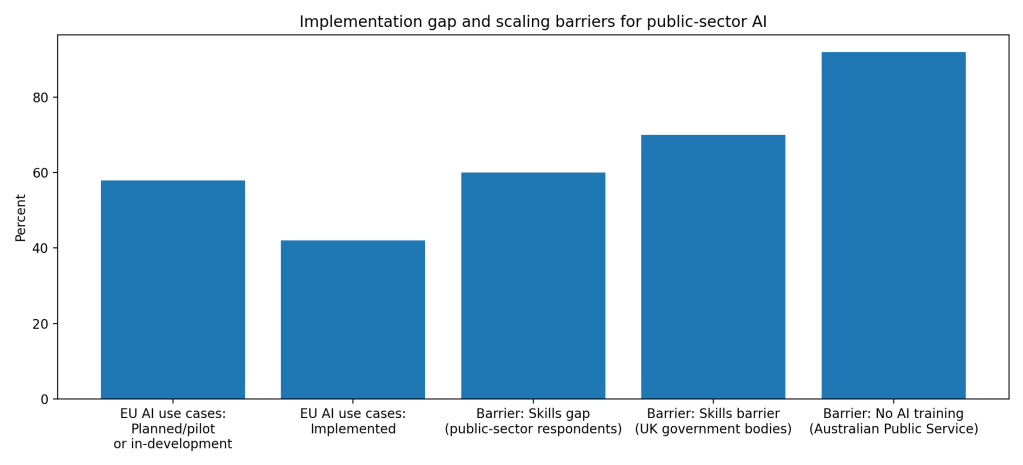
Scaling barriers also reflect broader public-sector AI patterns. OECD analysis reports that among nearly 1,500 documented public-sector AI use cases in Europe, 58 percent remain planned, pilot, or in-development rather than fully implemented (OECD). Only 42 percent have moved to active implementation.
Skills shortages remain the dominant barrier. OECD reports that 60 percent of public-sector respondents across five countries cited lack of internal skills as the primary obstacle. Seventy percent of UK government bodies reported skills gaps as a barrier, and 92 percent of Australian Public Service employees surveyed in 2024 reported no AI training (OECD). Without technical capacity, even proven models fail to scale.
Section 5: Where It Actually Works
Success appears in cities that tie analytics to one operational lever. Chicago focused narrowly on inspection ordering rather than full workflow redesign. Leaders measured a clear outcome, earlier discovery of critical violations, and integrated model outputs directly into scheduling decisions (City of Chicago).
FINDER deployments succeeded because inspectors retained enforcement authority while algorithms guided inspection priority. That partnership preserved professional judgment while improving targeting efficiency (Sadilek et al.).
Section 6: The Opportunity
Food safety generates rich structured data through inspections, complaints, and business registries. Stronger outcomes depend less on new algorithms and more on operational integration, workforce training, and procurement reform.
Actionable opportunities
• Standardize cross-department data pipelines so inspection data updates feed predictive models continuously (Firestone et al.)
• Fund inspector-facing training programs to address documented public-sector AI skills gaps (OECD)
• Begin with inspection ordering rather than full regulatory overhaul to reduce workflow disruption (City of Chicago)
• Track simple metrics such as unsafe hit rate and days-to-detection to demonstrate value early (Sadilek et al.)
• Develop shared municipal AI playbooks to reduce replication friction identified in other cities (GovTech)
Data Visualizations
Chart 1: Data-driven targeting vs traditional methods
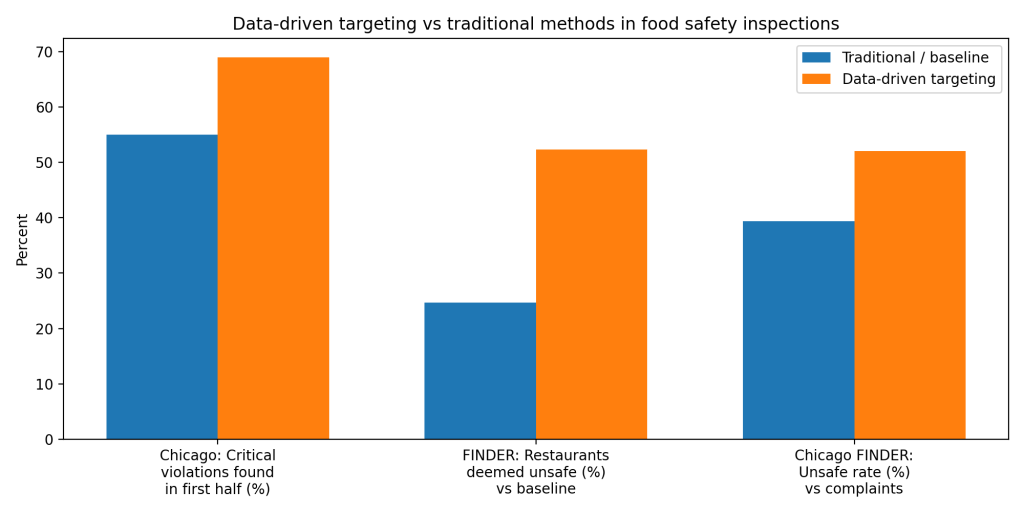
Chart 2: Real-world field outcomes
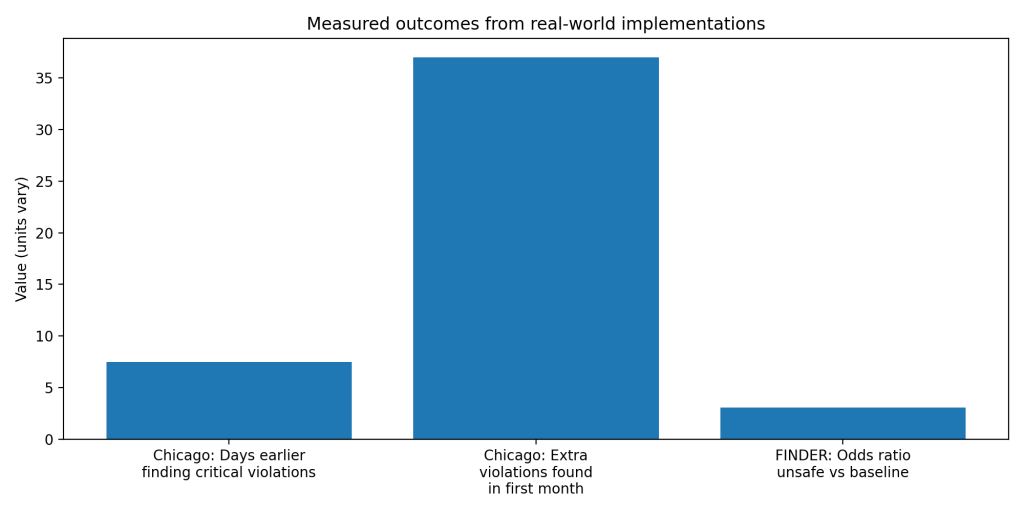
Chart 3: Implementation gap and scaling barriers
Works Cited
CDC. “Facts About Food Poisoning.” Centers for Disease Control and Prevention, 24 Nov. 2025, http://www.cdc.gov/food-safety/data-research/facts-stats/index.html.
City of Chicago. “Food Inspection Forecasting: Evaluation and Results.” City of Chicago, chicago.github.io/food-inspections-evaluation/.
Firestone, Michael J., et al. “A Public Health Informatics Solution to Improving Food Safety.” Preventing Chronic Disease, vol. 18, 2021, pmc.ncbi.nlm.nih.gov/articles/PMC8075413/.
GovTech. “Open Data Nation: Using Open Data to Integrate Predictive Analytics into City Operations.” 27 July 2016, http://www.govtech.com/data/Open-Data-Nation-Using-Open-Data-to-Integrate-Predictive-Analytics-into-City-Operations.html.
OECD. Governing with Artificial Intelligence: Implementation Challenges That Hinder the Strategic Use of AI in Government. Organisation for Economic Co-operation and Development, 18 Sept. 2025, http://www.oecd.org/en/publications/2025/06/governing-with-artificial-intelligence_398fa287/full-report/implementation-challenges-that-hinder-the-strategic-use-of-ai-in-government_05cfe2bb.html.
Oldroyd, Richard A., Mark A. Morris, and Mark Birkin. “Predicting Food Safety Compliance for Informed Food Outlet Inspections: A Machine Learning Approach.” International Journal of Environmental Research and Public Health, vol. 18, no. 23, 2021, p. 12635, http://www.mdpi.com/1660-4601/18/23/12635.
Sadilek, Adam, et al. “Machine-Learned Epidemiology: Real-Time Detection of Foodborne Illness at Scale.” npj Digital Medicine, vol. 1, 2018, http://www.nature.com/articles/s41746-018-0045-1.
Salaris, Stefania, et al. “Foodborne Event Detection Based on Social Media Mining: A Systematic Review.” 2025, pubmed.ncbi.nlm.nih.gov/39856905/.
Wang, Xiaowei, et al. “Application of Machine Learning to the Monitoring and Management of Food Safety.” Comprehensive Reviews in Food Science and Food Safety, vol. 21, 2022, ift.onlinelibrary.wiley.com/doi/10.1111/1541-4337.12868.
 Aethel.
Leave a comment