Section 1: The Problem
Around 30% of treated drinking water worldwide never reaches a paying customer. Utilities call this non-revenue water, and it represents an estimated $14 billion in annual economic losses (Rajan and Li).
In England and Wales, more than 20% of public water supply is lost to leakage, wasting over 50 liters per person per day (McMillan et al.). Many leaks are still discovered because customers report visible bursts, not because monitoring systems flag them early (McMillan et al.). Some underground leaks persist for months.
Traditional leak management relies heavily on minimum night flow, which assumes water use is lowest and stable overnight (McMillan et al.). Utilities compare expected night demand to measured flow and flag anomalies. In reality, night demand fluctuates with weather, tourism, industrial use, and social behavior. That variability leads to missed leaks or excessive false alarms.
Section 2: What Research Shows
Machine learning models significantly outperform rule-based methods in retrospective testing. McMillan and colleagues trained a hybrid variational autoencoder and support vector machine model using one year of 15-minute flow data from over 2,500 district metered areas managed by Yorkshire Water in the United Kingdom. The dataset contained roughly 10,000 labeled flow groupings (McMillan et al.).
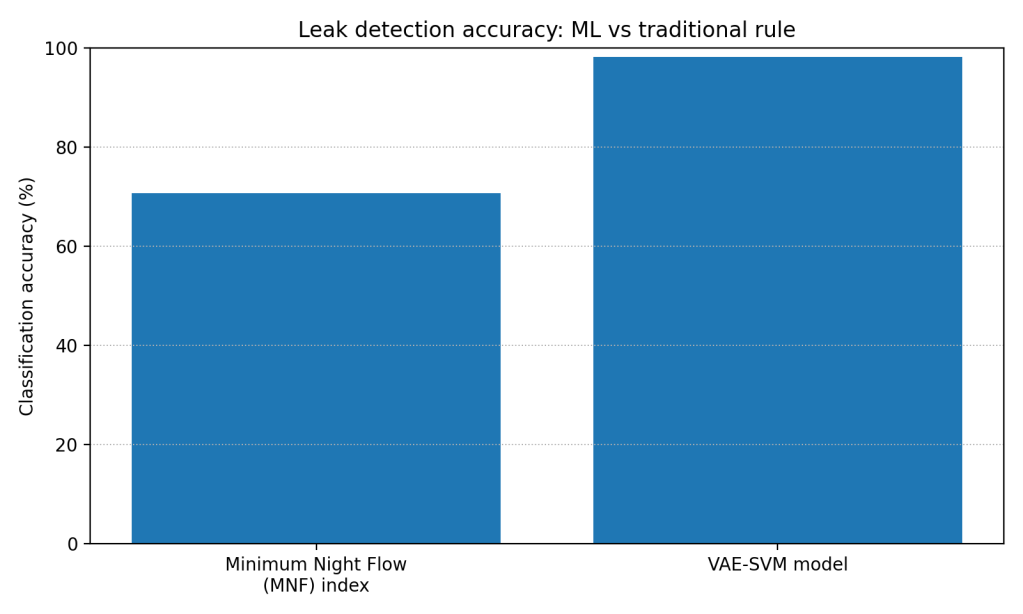
On a held-out test set, the model achieved 98.2% classification accuracy and an AUC of 0.996. Precision and recall both exceeded 95%, with an F1 score of 97.1% (McMillan et al.).
The same study compared results against a simplified minimum night flow index. The traditional MNF method achieved only 70.7% accuracy on the same dataset (McMillan et al.). The ML approach also removed the restriction to overnight analysis, allowing leak detection throughout the full daily cycle.
Section 3: What the Real World Shows
Some utilities have translated analytics into measurable operational outcomes. In Araçatuba, Brazil, a smart water initiative divided the city into 41 district metered areas and deployed flow and pressure sensors linked to an integrated monitoring platform (Shim et al.).
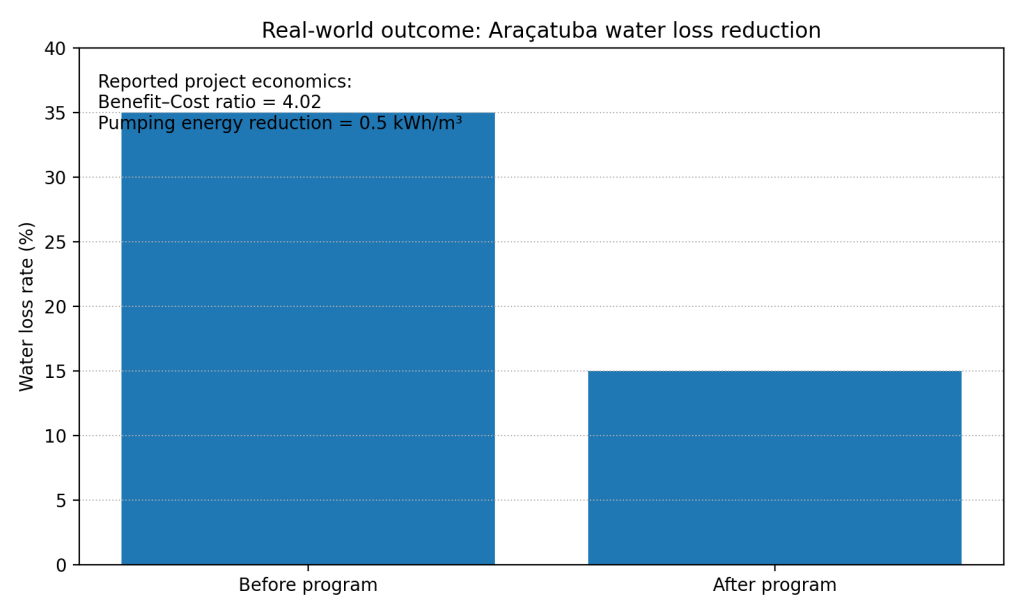
Water loss declined from 35% to 15% after implementation (Shim et al.). The reported benefit–cost ratio reached 4.02. The study accounted for reduced production cost of $0.4 per cubic meter and pumping energy reduction of 0.5 kWh per cubic meter (Shim et al.).
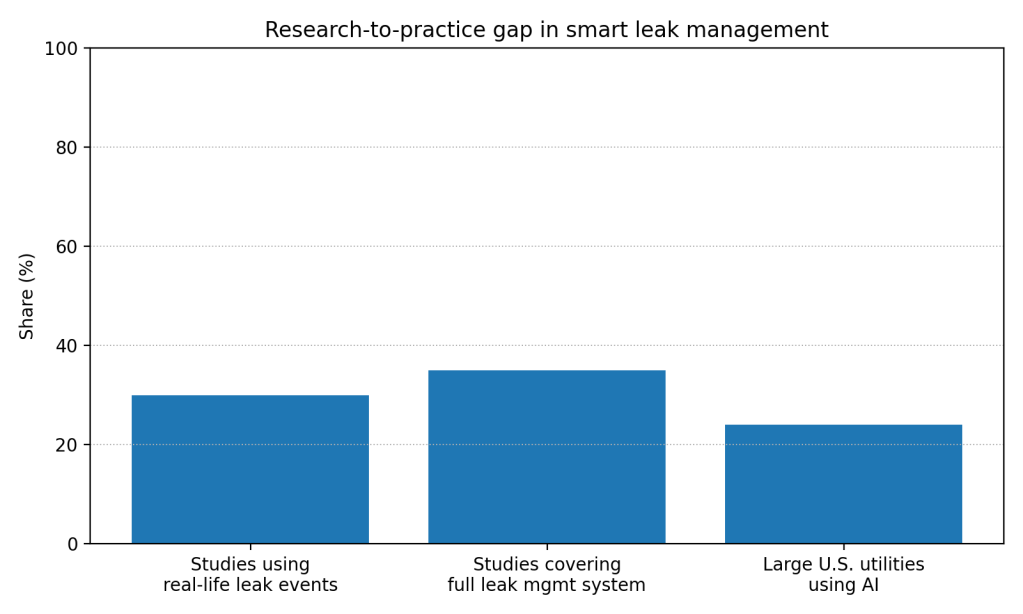
However, broader evidence shows real-world validation remains limited. A 2025 systematic review found that only 30% of leak detection studies used real-life leak events rather than simulated data (Rajan and Li). Only 35% addressed comprehensive end-to-end leak management systems rather than isolated detection algorithms (Rajan and Li).
Section 4: The Implementation Gap
The strongest barrier is evidence quality. If only 30% of studies use real leak events, many models are validated under cleaner conditions than utilities face (Rajan and Li). That limits confidence during field deployment.
Evaluation metrics also create friction. Many studies emphasize classification performance while neglecting detection time and false alarm burden (Rajan and Li). Operators must investigate each alert. Excessive false positives create alarm fatigue.
Infrastructure readiness slows adoption. A 2023 global survey of 64 utilities across 28 countries found uneven digital sensor coverage, long asset replacement cycles, and financial constraints limiting rapid modernization (Schmitter et al.). Without dense sensing networks, advanced analytics cannot perform effectively.
Organizational adoption lags as well. A 2024 case study review reported that only 24% of a sample of 49 major US water utilities had adopted some form of AI, and many deployments were partial or experimental rather than fully integrated into operations (Almheiri et al.). Research output exceeds operational capacity to implement.
Section 5: Where It Actually Works
Success occurs when analytics are embedded into operational systems. Araçatuba combined DMA segmentation, sensor deployment, centralized monitoring, and economic analysis into one coordinated program (Shim et al.).
The Yorkshire Water study aligned directly with existing district metered area infrastructure and benchmarked performance against current MNF practice (McMillan et al.). That practical framing improves integration potential.
Section 6: The Opportunity
Leak detection offers one of the clearest data science return-on-investment cases in infrastructure. Models show high performance. Select utilities show measurable savings. Adoption depends on operational integration.
Actionable steps
- Validate models using real leak events before scaling (Rajan and Li).
- Track false alarm rate and detection time alongside accuracy (Rajan and Li).
- Invest in sensor infrastructure before algorithm expansion (Schmitter et al.).
- Integrate analytics into daily workflow rather than standalone dashboards (Almheiri et al.).
- Tie deployment to economic metrics such as cost per cubic meter saved (Shim et al.).
Data Visualizations
Leak Detection Accuracy Comparison
Real-World Water Loss Reduction (Araçatuba)
Research-to-Practice Gap Indicators
Works Cited
Almheiri, M. S. M. A., et al. “Examining the Challenges of Implementing Artificial Intelligence in the Water Supply Sector: A Case Study.” Water, vol. 16, no. 23, 2024, 3539.
McMillan, L., et al. “Domain-Informed Variational Neural Networks and Support Vector Machines Based Leakage Detection Framework to Augment Self-Healing in Water Distribution Networks.” Water Research, vol. 249, 2024, 120983.
Rajan, G., and S. Li. “A Systematic Literature Review on Flow Data-Based Techniques for Automated Leak Management in Water Distribution Systems.” Smart Cities, vol. 8, no. 3, 2025, 78.
Schmitter, P., et al. “A Survey of Water Utilities’ Digital Transformation: Drivers, Impacts, and Enabling Technologies.” npj Clean Water, 2023.
Shim, K., et al. “Smart Water Solutions for the Operation and Management of a Water Supply System in Araçatuba, Brazil.” Water, vol. 14, no. 23, 2022, 3965.
 Aethel.
Leave a comment